 By
By Purchasing a low-cost gaming monitor—or any low-cost monitor—is difficult because there are hundreds of monitors with very identical specs. With a number of unique characteristics, the KTC 27M1 is able to differentiate itself from the competition. Although it’s not flawless, it’s a nice option if you’re looking for a low-cost multifunctional monitor.
Specs and Features
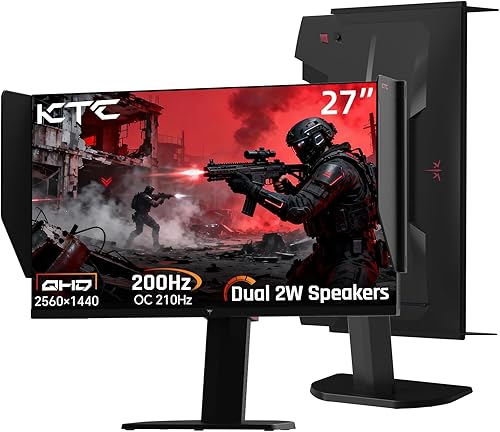
A 27-inch gaming monitor with a resolution of 2560 x 1440 is the KTC 27M1. Along with Adaptive Sync, FreeSync, and G-Sync, it also offers a refresh rate of up to 210Hz. To put it briefly, the display specs include all and more that I would anticipate from a low-cost gaming panel.
- 27-inch display with a 16:9 aspect ratio
- 2560 x 1440 is the native resolution.
- Type of panel: Fast IPS-LCD
- Rate of refresh: 210 Hz
- Adaptive sync: FreeSync, G-Sync, Adaptive Sync, Yes
- HDR: Indeed
- Two HDMI 2.0 ports, two DisplayPort 1.4 ports, and one 3.5mm headphone port
- Two two-watt speakers for audio
- Additional features include a protective hood, an ergonomic stand, and a headphone hanger.
- Retail price: $229.99
However, the KTC 27M1 adds a number of features that increase its attractiveness. It features a display hood and a headphone hanger (albeit the hood isn’t flawless, as I’ll explain in a bit). Additionally, the ergonomic stand offers greater adaptability than the majority at this price.
In terms of cost, the KTC 27M1 is competitively priced at $229.99 on Amazon. There are less priced monitors, but they usually have a lower refresh rate and/or 1080p resolution. The majority of 1440p displays with refresh rates between 180 and 240 Hz cost between $180 and $250.
Design
At first look, the KTC 27M1’s design appears conventional. It is mostly composed of matte-black plastic and has a few minor design elements, such as a silver strip with the words “Key to Combat” inscribed on the right side on the back. All of this is quite typical for a cheap gaming display.
But a few peculiarities jump out. The stand is tilted slightly away from the person using it. Although it’s a little strange, there is a benefit. This layout puts the display a little bit farther away from the user, which is useful if your workstation is small. Additionally, the stand features a carrying handle and a clicky swivel that can rotate 60 degrees in both directions.
In a way, the monitor also has a hood. A shield that fastens to the top or sides of a display is called a display hood. Usually, it’s used to make a display appear brighter and more accurate by lowering ambient light. This is also somewhat correct, albeit the top is missing from the hood. I’m a little perplexed as to why the top of the hood is missing, but it still somewhat reduces ambient light.
Returning to the stand, it’s fantastic. Compared to most monitors, the stand offers a greater range of ergonomic adjustability while having a compact, flat base. It has 150mm of height adjustment, 40 degrees of tilt, and up to 120 degrees of swivel. Additionally, it has the ability to rotate 90 degrees into portrait orientation. The 27M1 moves more than the majority of competing monitors, however most also feature ergonomic adjustability. Additionally, third-party monitor stands and arms can be used with a 100x100mm VESA mount.
Connectivity
KTC’s unusual yet arguably advantageous choices continue with the monitor’s connectivity. It has two HDMI 2.0 ports and two DisplayPort 1.4 ports for a total of four video inputs. Most budget monitors only have two or three video inputs.
It’s not all good news, though. The HDMI 2.0 ports only support a refresh rate up to 144Hz at 2560×1440. To be fair, it’s likely those ports will be used with game consoles, which don’t exceed 144Hz anyway.
The monitor also has a 3.5mm headphone jack. There are no USB ports, though, which is a minor disappointment. A USB 2.0 port is included but only used for firmware upgrades.
SDR image quality
Because of its significantly greater contrast ratio, the Lenovo Legion R27fc-30 merits special attention. This is made possible by the monitor’s Vertical Alignment (VA) panel, which has superior contrast and is the second most common choice for a low-cost monitor’s display panel after IPS. There is some trade and go, though, as the other graphs demonstrate the Legion’s shortcomings in other areas.
The 27-inch IPS-LCD display of the KTC 27M1 has a resolution of 2560 x 1440 pixels. and the monitor’s visual quality isn’t really indicated by those specs. The brightness, color, and contrast of IPS-LCD panels can vary greatly. What is the performance of the KTC 27M1?
KTC launches with a maximum SDR brightness of 535 nits. To be honest, that level of brightness is just too high for the majority of circumstances. However, the KTC 27M1 can work well if you require a monitor to utilize in an extremely bright setting. To lessen glare, the display also features an anti-glare coating.
Motion Performance
With overclocking, the KTC 27M1 can achieve a refresh rate of 210 Hz, or 200 Hz without it. That’s an odd number, but the motion clarity of the display didn’t seem out of the ordinary to me. In fast-paced games, the 210Hz refresh rate can offer exceptional fluidity and a responsive, instantaneous experience.
However, bear in mind that DisplayPort is the only way to access the full refresh rate. The maximum frequency for HDMI is 144 Hz.
For fluid frame pacing, the monitor also supports Nvidia G-Sync, AMD FreeSync, and Adaptive Sync. In my tests with an AMD Radeon 7800 XT, it performed as anticipated. However, this is standard equipment for a gaming monitor.
Although the improved pixel response time mode offered by KTC improves clarity, it may also result in distracting artifacts and an overly sharp appearance. Additionally, it features an MPRT mode that lessens motion blur by inserting black frames in between regular frames. MPRT has the drawback of reducing perceived brightness by around half, however because of the KTC’s exceptional brightness, this isn’t really a problem. Nevertheless, because MPRT can provide a “double image” illusion, it is somewhat of an acquired taste.
The KTC 27M1 is good for a low-cost gaming monitor, even though its general motion performance won’t win awards. Though quick lettering or small interface elements (like HP bars) can be a little difficult to see, fast-paced games typically have a fairly sharp appearance and readable details. It’s competitive in the market for low-cost gaming monitors and a significant improvement over any 60Hz panel.
Conclusion
The KTC 27M1 boasts good visual quality and distinctive characteristics that make it stand out, even though it’s not the greatest option for every game.
The KTC 27M1 has a low contrast ratio and struggles with dark settings, just like the majority of IPS-LCD displays. Additionally, the 27M1 lacks a software tool for managing monitor settings and USB connectivity.
However, the KTC 27M1 retaliates with a fantastic stand that offers robust color performance, four video inputs, and a wide range of ergonomic adjustability. Although it only covers two sides of the monitor, it does include a display hood.
If you’re looking for a low-cost, all-purpose monitor for business and gaming, I believe the KTC 27M1 is an especially attractive option. Along with improved motion clarity and fluidity, it provides the ergonomic adaptability and color accuracy that consumers may seek in a low-cost video creation display.