 By
By Do you recall mini-LED screens? If not, I don’t really blame you. Many of them were driven aside by the sharp decline in OLED monitor prices, even though they appeared to be a viable alternative to OLED a few years ago.
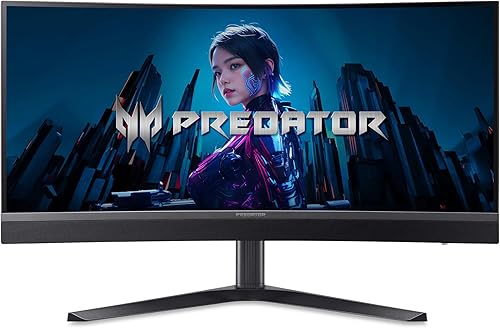
The Acer Predator X34 X0 is a new, reasonably priced Mini-LED choice for anyone who wants a very brilliant HDR and a low-glare display on a budget, yet Mini-LED still offers advantages.
Specs and Features
The dimensions and resolution of the Acer Predator X34 X0 are exactly the same as those of hundreds of 34-inch ultrawide monitors that have been sold in the last five years. It is a 34-inch diagonal display with a resolution of 3440×1440 and an aspect ratio of 21:9.
- 34-inch display with a 21:9 aspect ratio
- 3440 x 1440 is the native resolution.
- Type of panel: 1,152 dimming zones on a mini-LED VA panel
- Rate of refresh: 200 Hz
- Adaptive Sync: AMD FreeSync, indeed, High-end
- VESA DisplayHDR 1000 HDR
- Two HDMI 2.1 ports, one DisplayPort 1.4 port, one USB Type-C port with 65 watts of power delivery, and one 3.5mm audio out port
- Two five-watt speakers for audio
- MSRP: $599.99; current retail price: $479.99
The Mini-LED lighting with 1,152 individual dimming zones, combined with a Vertical Alignment (VA) LCD screen, is what sets this Acer apart from the majority of monitors. Additionally, the display features a USB-C port with up to 65 watts of power delivery and built-in speakers, both of which are unusual for a gaming panel.
The Predator X34 X0 was originally priced at $599.99 MSRP by Acer; however, it is currently on sale for $479.99 on Amazon. Given that Acer frequently offers extremely reasonable prices, I anticipate frequent sales of this model.
Design
Despite its simplicity, the Acer Predator X34 X0 has a nice appearance. With a faux heatsink on the back and an eye-catching fabric cover over the monitor’s speakers on the lower lip, it has a straightforward matte-black color scheme with a little flair.
The build quality is adequate yet mediocre. The monitor’s exterior is made of plastic, with the exception of the stand, which contains some metal. The few displays that defy this trend—such as certain Samsung Odyssey monitors—are more costly. This is prevalent for monitors in all price ranges.
This curved display has a 1500R curve; a lower number indicates a more pronounced curvature. The display’s image is noticeably distorted due to the obvious yet moderate curvature. However, I do tend to choose a curve that is even less aggressive.
An ergonomic stand with height, tilt, and swivel adjustments is included with the monitor when it is shipped by Acer. It works well, but I don’t like how deep and wide the stand base is. It’s so deep that I couldn’t put the monitor on my desk at the 26-inch depth I like for viewing. It would have been preferable to use a smaller stand base.
Connectivity
The Acer Predator X34 X0 has two HDMI ports, one DisplayPort port, and one USB-C port on the back. There are four video inputs in all, which is one more than the typical number for a gaming display. Including USB-C is also fantastic, especially for this price range. Certain companies, such as Alienware, are ignoring USB-C.
However, there is an issue: the HDMI connectors can only handle frame rates up to 100 Hz. You won’t get the best motion clarity from any HDMI source, which is disappointing.
Additionally, the display offers two USB-A downstream ports that increase USB connectivity when utilizing either a separate USB-B upstream port or the USB-C port. Although the USB-A ports’ version was not specified in Acer’s specifications, the speeds appear to be consistent with USB-A 3.2 Gen 1.
menus
The Acer Predator X34 X0’s back right flank has a joystick that provides rapid and responsive access to the on-screen menu system. The menu itself is neatly organized and offers a good selection of options for image quality, including six-axis color adjustment and appropriate gamma settings. However, I think the wording could be made simpler to read and larger.
The majority of monitor settings within Windows can be accessed with Acer’s Acer Display Widget Windows program. It functions fairly well, however, in comparison to comparable software from Asus and Dell, the user interface seems unfinished.
A timer and an on-screen crosshair are only two of the game choices available. One noteworthy feature is a mode with multiple size selections that limits the monitor’s visible area to a narrower, 16:9 aspect ratio. If you wish to play an older PC game that isn’t compatible with ultrawide resolutions, that’s helpful.
Audio
Acer wants you to know that the Predator X34 X0 has two five-watt speakers. The lower lip of the monitor, which houses the speakers, has a high-end appearance due to the cloth covering it. The audio quality is passable, but you should be cautious.
The good news is that the two five-watt speakers produce a fuller, more accurate sound and are significantly louder than standard monitor speakers. They are fun if you’re playing a game where the audio experience isn’t the main focus or if you want to listen to background music while working.
However, the Predator X34 X0’s speaker capabilities are still limited because it lacks an integrated woofer. Because of the small soundstage, situations with a lot of bass may make the audio sound muddy.
Additionally, I heard a faint but noticeable buzz coming from my review unit’s speakers, which seemed to be caused by improperly shielded speaker wire. It was there, but I didn’t notice it until I was using the monitor for more than a week.
For more immersive games, players will desire headphones, although the speakers are adequate for the price, and the majority of competitors lack speakers altogether.
SDR image quality
The LCD panel on the Acer Predator X34 X0 is oriented vertically (VA). This kind of panel is widely used in hundreds of televisions and monitors.
The Mini-LED lighting, however, is more peculiar. For improved control over brightness and contrast, it has 1,152 separate dimming zones that may be turned on and off independently. The majority of LCDs simply contain a few LED backlights positioned along the display’s edges.
The Acer Predator X34 X0 offers a maximum brightness of 379 nits in SDR, to start. That is bright, but not exceptionally bright for an LCD screen. The monitor may become brighter as the HDR findings indicate, but it seems Acer set a brightness limit in SDR.
It’s also important to note that reflections are rarely a problem because the display has a matte finish with mild glare. This means that under a wide range of lighting conditions, the display appears bright and readable.
I tested a contrast ratio of 8,930:1 at 50% of maximum brightness, as can be seen above. However, contrast can change significantly based on the display’s brightness, which is unusual for most panels.
At lower brightness settings, where the display’s minimum brightness registers a perfect result of zero nits, the contrast ratio is practically limitless. In comparison, I recorded a contrast ratio of 16,470:1 at 100% brightness, which is still an excellent outcome.
The contrast ratio is practically unlimited because I believe the majority of gamers will use this panel at lower SDR brightness levels.
However, unlike OLED panels like the Alienware AW3425DW, the Mini-LED backlight cannot dim or brighten individual pixels, which makes the problem even more complicated. Even though the Predator X34 X0 has 1,152 dimming zones, little bright objects, such as your mouse pointer, will still have a splotchy “halo” or “blooming” effect when they are on a dark background.
In games, this is frequently less evident, but on the Windows desktop, it is more noticeable. A clear blooming effect can be produced by something as basic as white writing on a dark background. If you enable subtitles in games or movies, this will also be a problem.
This doesn’t bother me too much, but your experience may differ. While some might barely notice, others would think it’s totally inappropriate.
It’s also important to note that the dynamic backlight can be switched off. That’s a great alternative if you don’t like how blooming appears in Windows desktop apps, but I wouldn’t suggest it for games because you’ll miss the contrast advantages of the Mini-LED backlight.
Performance
The refresh rate of the Acer Predator X34 X0 is up to 200 Hz.
The Predator X34 X0 can seem rather smooth because that is undoubtedly much greater than 60Hz. However, 200Hz no longer feels as unique as it once did because 240Hz monitors are now widely available. For less than $300, you can purchase 34-inch ultrawide displays with a refresh rate of 240 Hz.
As a result, the motion clarity of the Predator X34 X0 is just passable given the price. In fast-paced content, it is fluid and quite crisp. I could use the monitor for a variety of game genres without ever experiencing a clarity problem. You won’t be impressed, though, if you’ve ever used a 240Hz OLED or even a 240Hz IPS display with a short pixel refresh time.
Additionally, as previously stated, the 200Hz frame rate is limited to DisplayPort and USB-C. HDMI is stuck at 100 Hz. That’s a little strange. I even suspected there might be a typo in the monitor’s specifications, but after using HDMI, I was able to verify that the limit at 3440×1440 resolution is 100Hz.
With genuine AMD FreeSync Premium certification, the Predator X34 X0 is capable of adaptive sync. Although it didn’t function with an Nvidia-powered laptop I had on hand, Nvidia G-Sync support is not official.
Conclusion
An intriguing addition to the sub-$500 display market is the Acer Predator X34 X0. It offers a Mini-LED screen with strong contrast, a broad color gamut, high brightness, and good HDR performance; however, these features are accompanied by a potentially irritating “blooming” effect.
Although the monitor has a refresh rate of only 200Hz (and only 100Hz over HDMI), which isn’t very spectacular for nearly $500, it does have USB-C and good speakers, both of which are advantages at this price.
Because of this, the Predator X34 X0 is a confusing display to think about. The Predator X34 X0 is a good option if you want a bright ultrawide monitor with respectable HDR and USB-C connectivity in the under-$500 price range, though I can’t suggest it to everyone.