 By
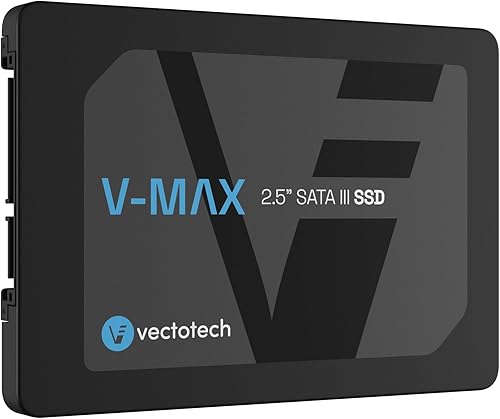
By With VectoTech’s V-MAX SATA SSD, you can expand your system’s storage capacity by up to 16TB per unit without having to deal with the unreliable and slow performance of an HDD’s rotating platters. That’s 16TB on a single drive, yes.
As a result, stacking V-MAX drives can provide your system with 128TB of rapid (in comparison to HDDs) storage, as most systems have 4 to 8 SATA ports. Unfortunately, it won’t be inexpensive.
Oh, the unspoken problem. Although we adore the NVMe interface and its exceptional performance, it quickly consumes PCIe resources and has a maximum capacity of 8TB per drive in the consumer market. More than one or two NVMe SSDs cannot be supported by many systems.
However, those same systems typically offer four to eight SATA ports, so you can install a lot more SATA SSDs than NVMe types like the Asus Hyper M.2 x16 Gen5 without an add-in card.
SATA SSDs, not NVMe, were the ones that revolutionized storage. CPU increases throughout the years were mostly mitigated by slow HDD access (seek) times and throughput prior to SATA SSDs.
Features
The V-Max uses a Phison PS3112-S12 controller and 112-layer Kioxia TLC NAND. DRAM is provided with 256MB per terabyte on the 1TB and 2TB models, and 1GB per terabyte on the 4TB, 8TB, and 16TB units.
VectoTech warrants the V-MAX for three years, and provides 750TBW (terabytes that can be written) per terabyte of capacity for the 1TB and 2TB models, 3420TBW for the 4TB, 3125TBW for the 8TB, and 2,812.5TBW for the 16TB. Why the nonlinear TBW ratings, I can’t tell you, but all are beyond the industry norm. In the three larger capacities, way beyond the norm.
And what really sets this product apart is its capacity per unit. There is only one other larger-than-4TB SATA SSD available that I know of. However, it is “only” 8TB and costs a lot more than the 8TB V-MAX (see the bad news below). The V-Max makes use of a 112-layer Kioxia TLC NAND and a Phison PS3112-S12 controller. The 1TB and 2TB variants come with 256MB of DRAM per terabyte, while the 4TB, 8TB, and 16TB models come with 1GB per terabyte.
In this instance, the years may be the more concerning element because it is quite improbable that consumers will submit more than those ratings in three years. The majority of internal SSDs have a five-year warranty.
It’s more concerning, to be sure, but I haven’t witnessed an internal SSD fail in more than ten years, so that’s more of a minor issue.
What is the V-MAX’s price?
The capacities of the VectoTech V-MAX are 1TB/$69, 2TB/$179, 4TB/$299, 8TB/$799, and 16TB/$1,799. Yes, the pricing is similar to that of NVMe, but large-capacity SSDs are not made overnight.
Large-capacity consumer SSDs are not produced by most suppliers. The 8TB Micron 5210 Ion, the only other one I could find that is currently on the market, costs $1,100, which is significantly more than the 8TB V-MAX. Additionally, it is QLC rather than TLC like the V-MAX.
Comparatively speaking, two 16TB HDDs only cost about $500. Why two? Data should never be trusted to an HDD alone unless it is mirrored to another one or otherwise backed up. Although it hasn’t happened in a long time, I’ve had far too many go bad; quality has significantly increased over time.
How fast is the V-MAX?
With its 6Gbps speed, SATA III may reach a maximum sustained throughput of 550MBps, which is almost twice as fast as a contemporary 3.5-inch HDD but much slower than NVMe. HDD seek times are tens of milliseconds, whereas SSD seek times are between 0.04 and 0.1 milliseconds. The range of NVMe is 0.01–0.02 ms.
In order to compare them to the V-MAX, I retested two earlier SATA SSDs on our new testbed: Samsung’s 870 QVO and Seagate’s IronWolf. There isn’t much of a difference because of the SATA performance ceiling, but if you can get the Samsung 870 QVO, you should avoid it for huge writes.
Conclusion
Yes, the 16TB V-MAC can be your ideal solution if capacity is your top concern and you’re looking for something more powerful and quicker than a hard drive in one package. Additionally, it’s essentially the only game available for maximizing a consumer PC’s SSD storage without the need for numerous add-in cards.
Nevertheless, the 16TB V-MX is not for the faint of heart—that is, the pocketbook. That would be difficult for me to justify in terms of HDDs. However, I don’t work on projects with enormous amounts of data or video that have performance issues.
In other words, you are responsible for assessing financial suitability on your own.