 By
By While there are many options available to gamers looking to purchase a desktop, iBuyPower’s RDY Element Pro range stands out for its exceptional pricing. It is reviewed here in its R07 ready-to-ship configuration ($2,599 as tested), which combines an Nvidia GeForce RTX 5070 Ti graphics card with an AMD Ryzen 7 9800X3D processor for remarkable gaming performance. Excellent beginning peripherals are included in the package, the system’s eye-catching glass-heavy chassis looks every bit as high-end as its pricing suggests, and iBuyPower offers a substantial guarantee. It receives our Editors’ Choice award for midrange gaming desktops as a non-mainstream substitute for the Alienware Aurora.
Configurations
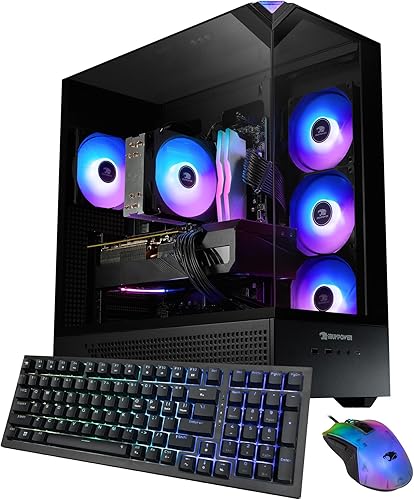
Custom-built systems and a variety of ready-to-ship RDY models, such as the RDY Element Pro R07 discussed in this review, are sold by iBuyPower. A liquid-cooled AMD Ryzen 7 9800X3D CPU, an Nvidia GeForce RTX 5070 Ti GPU, 32GB DDR5 RAM, a 2TB SSD, and Windows 11 Home are all included in this powerful gaming PC. It surpasses most rivals with a hefty guarantee of two years for parts and three years for labor, and it also comes with an RGB-lit keyboard and mouse.
There are many options available to buyers with different budgets. As of this writing, iBuyPower offers eight pages of RDY systems for sale on its website; other configurations can be found at stores like Best Buy and Newegg. For instance, you might replace our test machine’s GPU with an AMD Radeon RX 9070 XT and update the CPU to an AMD Ryzen 9 9950X3D, which costs $100 more. The majority of logical CPU/GPU combinations are probably available in an RDY variant with this kind of option. Naturally, you may also select a bespoke model that is made to your exact specifications and is shipped by iBuyPower in less than a week.
Although iBuyPower usually offers low prices, our review model, which costs $2,599, is significantly more expensive than the $2,199 Alienware Aurora, which has an Intel Core i7 265KF and other comparable specifications. (However, in terms of sales, the iBuyPower model has outperformed the Aurora by at least $100.) In contrast, the $1,879 Lenovo Legion Tower 5 Gen 10 comes with a smaller 1TB SSD, a GeForce RTX 5070, and an older Ryzen 7 7800X3D. Notably, the RDY 07 outperformed the competition in most graphics and gaming tests, and neither competitor has a standard warranty as comprehensive as iBuyPower’s.
Design
This iBuyPower Element Pro is a great option for anyone looking for a visually striking desktop. Its aquarium-style chassis offers a seamless interior view thanks to its edge-to-edge front and left panels. With a largely glass surface and a cutout for a detachable exhaust grate, the top panel carries on the concept. This construction has a high-end, contemporary look when paired with the remainder of the case’s rolled steel structure. With dimensions of 17.4 by 9.1 by 20 inches (HWD), the Element Pro is firmly positioned in the middle of the tower.
This tower is filled with RGB lighting. With controllable RGB lighting on the housing of each fan blade, four 120mm fans—three side intakes and one rear exhaust—create a layered, colorful illumination. The visual extravaganza is enhanced by additional lights on the DDR5 DIMMs and CPU waterblock. To access lighting controls, users must manually download the Asus Armoury Crate program because iBuyPower does not preinstall it.
The motherboard, RAM modules, and an addressable RGB strip are all compatible with Aura Sync. The DIMMs are the only lighting zones that are not controlled by that strip, so it is not possible to change the colors of individual fans. Per-fan control isn’t supported out of the box, although it could be feasible to add an aftermarket controller.
Tests of Productivity and Content Creation
Our main overall benchmark tests a system’s performance in productivity applications, including word processing, spreadsheets, and web browsing. A PC’s storage throughput is measured by its Full System Drive subtest.
We also use three additional CPU-centric or processor-intensive tests: We see how long it takes the video transcoder HandBrake 1.8 to convert a 12-minute clip from 4K to 1080p resolution; Maxon’s Cinebench 2024 renders a complex scene using that company’s Cinema 4D engine; and Primate Labs’ Geekbench 6.3 Pro simulates popular apps ranging from PDF rendering and speech recognition to machine learning.
Lastly, some automated tasks in Adobe Photoshop 25 are used by workstation manufacturer Puget Systems’ PugetBench for Creators to evaluate a PC’s image editing capabilities. Our main overall benchmark tests a system’s performance in productivity applications, including word processing, spreadsheets, and web browsing. A PC’s storage throughput is measured by its Full System Drive subtest.
We also use three additional CPU-centric or processor-intensive tests: We see how long it takes the video transcoder HandBrake 1.8 to convert a 12-minute clip from 4K to 1080p resolution; Maxon’s Cinebench 2024 renders a complex scene using that company’s Cinema 4D engine; and Primate Labs’ Geekbench 6.3 Pro simulates popular apps ranging from PDF rendering and speech recognition to machine learning.
Lastly, several automated tasks in Adobe Photoshop 25 are used by workstation manufacturer Puget Systems’ PugetBench for Creators to evaluate a PC’s image editing capabilities.
The benchmark, where 4,000 points usually indicate good performance, was easily passed by all of these machines. With a score of almost 10,000 points, the Element Pro was outstanding and seldom exceeded. The Alienware trailed somewhat behind the Corsair. In the storage test, the Element Pro also shown competitiveness, although Corsair was unbeatable.
A more complex picture is shown by the CPU tests. According to Cinebench, Geekbench, and HandBrake findings, the Element Pro’s Ryzen 7 9800X3D was unable to match the raw multi-core power of Alienware’s Core Ultra 7 265KF. Despite being in a higher tier, the Corsair Core Ultra 9 285K dominated. Nevertheless, the Element Pro performed exceptionally well on a single core.
Gaming and Graphics Tests
We use five animations or game simulations from UL’s 3DMark test suite to examine the visual capabilities of every PC. The Vulkan graphics API is used to gauge GPU performance in the first two, Wild Life (1440p) and Wild Life Extreme (4K). The following two subtests, Steel Nomad’s regular and Light subtests, evaluate gaming geometry and particle effects using APIs that are increasingly often used in game development, such as Metal and DirectX 12. Lastly, we use 3DMark Solar Bay to assess the performance of ray tracing.
The in-game standards of Call of Duty: Modern Warfare 3, Cyberpunk 2077, and Formula One 2024 serve as the foundation for our real-world gaming testing. These three titles feature competitive shooter, open-world, and simulation games, respectively, and are benchmarked at full HD (1080p or 1200p), 2K (1440p or 1600p), and 4K (2160p) resolution.
On PCs, we perform the Call of Duty benchmark with the Extreme graphics preset. This method aids in assessing high-frame-rate capability because the test may generate triple-digit frame rates even on low-end PCs. In contrast, we run the full Ray Tracing Overdrive preset without DLSS or FSR in our Cyberpunk 2077 test settings, which are designed to push PCs to their limits. Lastly, F1 2024 serves as our test for the efficacy of DLSS (or FSR on AMD systems), showcasing a GPU’s ability to use upscaling and frame-rate-boosting technologies.
Real-world gaming benchmarks clearly show the iBuyPower as the superior performer, at least in the CPU-bound 1080p scenarios, even though the majority of synthetic 3DMark scores place the iBuyPower Element Pro and the Alienware in a dead heat (with the exception of Steel Nomad). Despite the Corsair’s superior RTX 5080, the Element Pro’s Ryzen 7 9800X3D continuously produced top results there. Nevertheless, at GPU-limited 4K resolution, Alienware reduced the disparity.
Conclusion
A carefully designed gaming desktop that offers both appearance and functionality is the iBuyPower Element Pro. Although there aren’t many options for lighting customization, the RGB lighting adds visual flair, and the smooth glass panels provide uninterrupted interior vistas and a premium impression. Our unit’s combination of a Ryzen 7 9800X3D and a GeForce RTX 5070 Ti proved to be powerful in terms of performance, particularly for esports.
In addition to its power, the Element Pro is noteworthy for its long warranty, decent integrated peripherals, and outstanding connections. All things considered, it’s a strong substitute for the Alienware Aurora and a worthy winner of our Editors’ Choice award for midrange gaming desktops.