 By
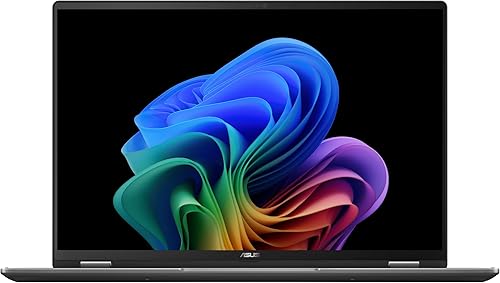
By Windows 2-in-1s simply aren’t as good as they once were, albeit it’s probably for the best. We now have 2-in-1s like the Asus Vivobook 16 Flip, which boasts a 16-inch OLED touchscreen, in place of little thin-and-lights with kid-sized displays. It’s a flexible Windows computer with good performance, but it’s clearly not an iPad substitute.
Specs and features
The Asus Vivobook 16 Flip, which costs $1,249.99 at Costco, is the maximum configuration that I was given to review. It features a 16-inch OLED touchscreen, 32GB of RAM, 1TB of storage, and an Intel Core Ultra 7 258V octo-core processor. Even if none of these features stand out by themselves, they are reasonably priced at $1,249.99.
- Model number: TP3607
- CPU: 258V Intel Core Ultra 7
- Memory: 32GB LPDDR5x-8533 Graphics/GPU: Intel Arc 140V
- NPU: 47 TOPS
- Display: 16-inch OLED touchscreen with 2880 x 1800 pixels at 120 Hz
- 1TB M.2 PCIe 4.0 solid state drive for storage
- Webcam and microphone: 1080p with a physical privacy shutter and a twin microphone array
- Connectivity: 1 USB-A 3.2 Gen 1, 1 HDMI 2.1, 1 3.5mm, MicroSD card reader, 1 Thunderbolt 4 with DisplayPort and Power Delivery and up to 40Gbps data, 1 USB-C 3.2 Gen 2 with DisplayPort and Power Delivery and up to 20Gbps data
- Bluetooth 5.4 and Wi-Fi 7 for networking
- No biometrics
- Dimensions: 13.98 x 9.62 x 0.69 inches; battery capacity: 75 watt-hours
- 3.97 pounds in weight
- Operating System: Windows 11 Home; MSRP: $1,349.99; usual retail price from Costco: $1,249.99
A less expensive option featuring an Intel Core i7-256V, 16GB of RAM, and 512GB of storage is also available from Asus. Asus sells that model for $1,049.99, but Amazon is presently selling it for $1,019.99.
If you can afford it, I believe you should go for the more costly setup. For an additional $200 to $230, you can have twice as much RAM and storage along with a processor upgrade.
The design of the Asus Vivobook 16 Flip is modest at first glance. It’s a shiny silver-gray slab with no flair and little branding.
Naturally, this also applies to many mid-range laptops. However, the Vivobook 16 Flip’s design really shouts “budget!” to me. I believe it’s the laptop’s bottom, which has rubber feet and big ridged fan vents. Although it’s a functional design, it doesn’t stand out.
The same is true of build quality. In normal laptop use, the laptop feels sturdy and offers little flexibility. But when you take up the laptop from a corner, the chassis flexes sufficiently to produce a few unsettling creaks and groans. This adds to the low-cost vibe of the Vivobook 16 Flip.
The Vivobook 16 Flip, as its name suggests, is a 2-in-1 with a 360-degree display that can flip or spin to make it flush with the laptop’s bottom, turning it into a tablet. Despite being light for a laptop of this size, this 16-inch device weighs almost four pounds, which makes using a tablet uncomfortable.
Connectivity
With the Asus Vivobook 16 Flip,, Asus offers a decent combination of physical connectivity. It has USB-C 3.2 Gen 2 and Thunderbolt 4 ports with Power Delivery and DisplayPort. This implies that both can be used to charge the laptop or connect screens.
Additionally, a single USB-A 3.2 Gen 1 port is present. A MicroSD card reader, a 3.5mm audio connector, and an HDMI 2.1 port are further connectivity features.
This range of connectivity is good, but not particularly impressive. The majority of laptops that compete feature at least one USB-A port and a comparable number of USB-C connectors. Contrary to popular belief, laptops and 2-in-1s costing more than $2,000 are more likely to forgo USB-A and HDMI, whilst rivals in the Vivobook 16 Flip’s price range are more likely to do so.
Performance
The Intel Core Ultra 7 258V was found in theAsus Vivobook 16 Flip, that I evaluated. It is an eight-core CPU with four performance cores, four low-power-efficient cores, and a maximum clock speed of 4.8GHz. Additionally, it offers a powerful version of Intel’s Arc 140V integrated graphics. A substantial 32GB of RAM and 1TB of solid-state storage were included with the Intel processor.
A comprehensive system benchmark, the Asus Vivobook 16 Flip gets off to a great start. The Vivobook 16 Flip performs well in this test, which tends to favor highly multi-threaded CPU performance a little less and does benefit from a GPU. It outperforms more costly 2-in-1s like the Samsung Galaxy Book5 Pro 360 in terms of score.
In the highly multi-threaded benchmark Cinebench 2024, the story is rather different. Just half of the eight cores in the Intel Core Ultra 7 258V are performance cores, as was previously noted. Several rivals provide more high-performance cores. Here, the AMD Ryzen AI 7 350 outperforms it.
But in Handbrake, things shift once more. For an Intel Core Ultra 7 258V laptop, the Vivobook 16 Flip offers a solid grade. Over the course of this test, it appears that the laptop’s aggressive cooling—which is somewhat noisy at full load—is better able to keep the chip operating at full power.
Battery life and portability
The Asus Vivobook 16 Flip, contains a 75-watt-hour battery. That results in an average battery life and is a typical size for a Windows laptop.
Fortunately, Asus’ Vivobook 16 Flip passed bestcomputerfinder regular battery test, which involves looping a 4K version of the short film Tears of Steel for more than 14 hours. It’s a long time! Unfortunately, a lot of Windows laptops in this category have comparable or even longer battery lives.
Real-world battery life will typically be a little shorter, but it should be possible to get about 10 hours and 14 hours if you limit your usage to less demanding programs, adopt a low-performance power profile, and set the display to about half of its maximum brightness.
Additionally, charging this laptop is simple. It can be charged using a variety of third-party USB-C chargers and comes with a compact 65-watt USB-C power converter. In roughly four or five hours, even a contemporary phone charger may fully charge it.
Conclusion
Although it frequently falls short of expectations, the Asus Vivobook 16 Flip, is a well-rounded 16-inch 2-in-1 that generally offers reasonable value when compared to the competition. Its performance is its strongest point; it was frequently a little faster than the alternatives. Additionally, the Vivobook offers an OLED touchscreen at a reasonable price. Although it lacks a standout feature that would set it apart from the competition, it also avoids any significant issues that could make it a difficult pass. At $1,249.99, it’s also a terrific deal.