By
By Samsung’s Odyssey OLED G6 G60SF and the Asus ROG Strix XG27AQDPG are the two latest 500Hz QD-OLED monitors that were released in quick succession. Ten years ago, an OLED monitor with a 500Hz refresh rate was only a pipe dream. Today, it’s a reality, and the effects are astounding.
Specs and Features
The refresh rate, which can reach a maximum of 500Hz, is undoubtedly the main attraction here. A few other firms, such as Samsung, also offer a 500Hz OLED display, but that’s a new high for OLED and an exceptionally high refresh rate for any panel.
- 26.5-inch display with a 16:9 aspect ratio
- Resolution in native: 2560 x 1440
- Type of panel: QD-OLED Samsung
- 500 Hz is the refresh rate.
- Adaptive sync: Nvidia G-Sync, AMD FreeSync Premium Pro, and Adaptive Sync Complementary
- HDR: True Black VESA DisplayHDR 500
- Ports: 1x USB-B, 3.5mm audio jack, HDMI 2.1, and DisplayPort 1.4. Two USB-A ports and 3.2 Gen 1 upstream, 3.2 Gen 1 downstream
- No audio
- Extra features: Neo Proximity, Aura Sync lights, and tripod mount Sensor
- Cost: $899.99 MSRP
Aside from refresh rate, gaming is the primary focus of the ROG Strix XG27AQDPG. It is approved by VESA DisplayHDR 500 True Black and supports a wide range of adaptive sync. As of early October 2025, the monitor is being sold for its MSRP of $899.99. That makes it a bit more expensive than Samsung’s counterpart, the Odyssey OLED G6, which costs $850.
Design
The more current ROG Strix XG27AQDMG and the ASUS ROG Strix XG27AQDPG have the same appearance. Slim bezels surround the panel, and a tiny red LED Asus ROG emblem sits on the chin, giving it a stealthy yet aggressive matte-black appearance.
Additionally, there is an RGB-LED Asus ROG logo if you turn it around. The RGB-LED lighting on the rear of the Samsung Odyssey OLED G6 G60SF (and some of its rivals) is brighter than this one. However, Asus’ Aura Sync, a reliable software tool for handling RGB-LED customization, can be used to manage the lighting and coordinate it with other Asus devices.
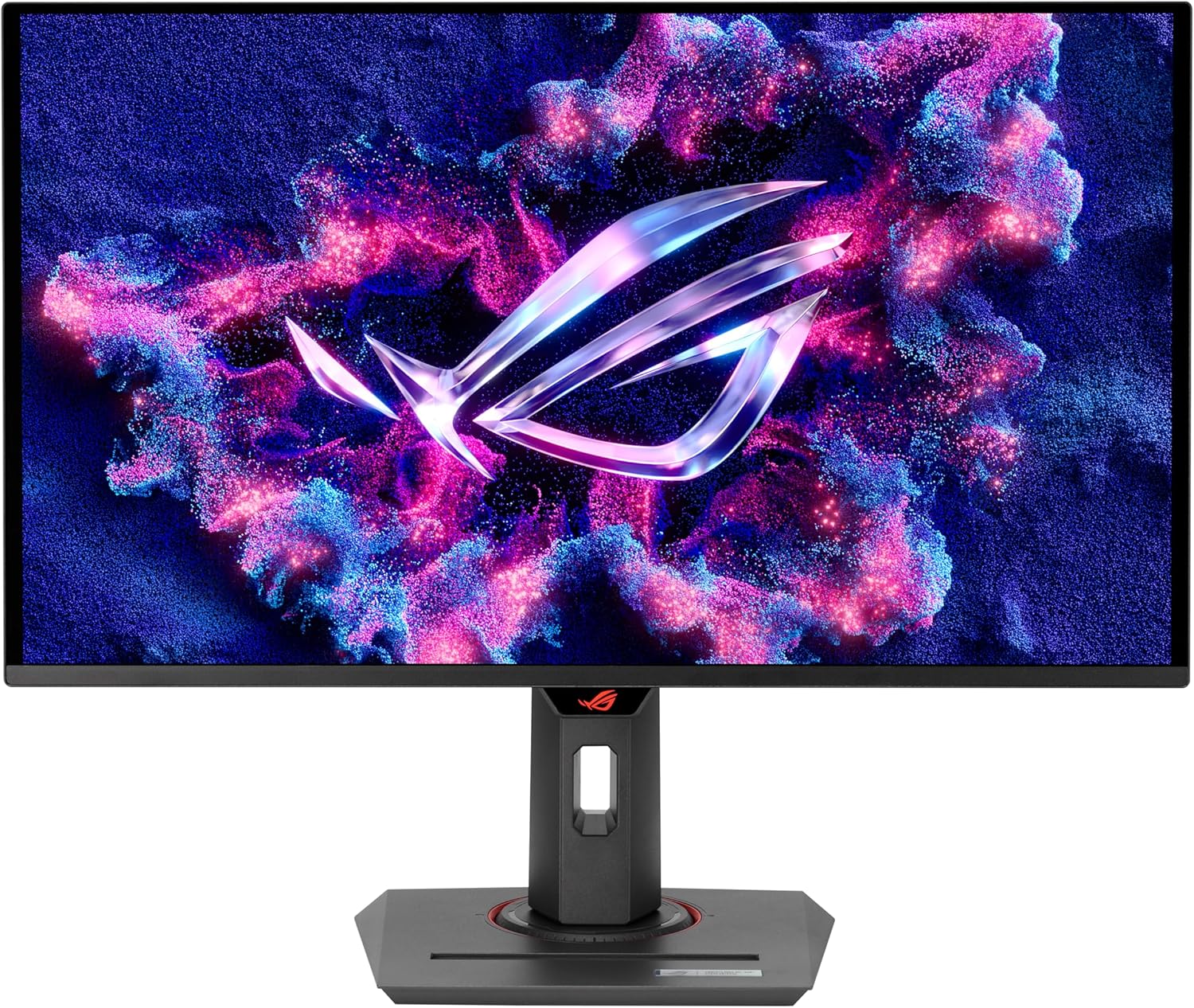
ASUS ROG Strix 26.5” 1440P QD-OLED Gaming Monitor (XG27ACDNG) -QHD (2560×1440), 360Hz, 0.03ms, Custom Heatsink, OLED Care+, G-SYNC Compatible, 99% DCI-P3, DisplayWidget, AI Gaming, 3yr Warranty
On a desktop, the Asus ROG Strix XG27AQDPG is supported by a small square stand. In the past, Asus insisted on large, tripod-style stands, but they have since changed their mind. Consequently, the monitor occupies minimal desk space. Additionally, the stand has ergonomic tilt, swivel, and height adjustments. Additionally, it can rotate 90 degrees into portrait mode.
A 1/4-inch tripod mount is one of the stand’s distinctive features. It is added so that camera equipment, like a camera or light, can be mounted above the monitor. Despite being aimed toward live broadcasts, anyone who frequently participates in video calls may find it helpful. Competitive monitors do not have this feature.
Connectivity
Another feature that the Asus ROG Strix XG27AQDPG lacks is USB-C. Due to its regrettable absence, several contemporary laptops that only have USB-C connections for video-out will find it difficult to connect to the monitor.
Additionally, USB-A connectivity is restricted. A single USB-B upstream port drives the two USB-A 3.2 Gen 1 downstream ports. Not much else can be connected with that, just a wired keyboard and mouse. A 3.5mm audio connection completes the connecting possibilities by allowing audio pass-through.
Two HDMI 2.1 connections and one DisplayPort 1.4 port offer video connectivity, and they can all support the monitor’s 2,560 x 1,440 resolution at its highest refresh rate of 500 Hz.
For a $900 monitor, the Asus ROG Strix XG27AQDPG has limited connectivity, but this is standard in the gaming industry. The number of ports on Samsung’s Odyssey G6 G60SF is comparable. In 2025, Alienware monitors will continue to have minimal connectivity. Customers looking for USB-C monitors with power delivery can have a look at the MSI MPG 272URX.
menus and audio
With the Asus ROG Strix XG27AQDPG, Asus offers a wide range of image quality customization options. Among its many features are a lengthy list of image quality presets, six-axis color calibration, and color temperature and gamma settings that aim for particular values.
The monitor also has features designed with gamers in mind. To improve visibility, its “AI crosshair” automatically changes color. Two “aspect ratio control” settings are also available. While the latter limits the viewing area to a 24.5-inch 16:9 aspect ratio, which is common among competitive gamers, the former limits the viewable area to a 4:3 display, which can help play older games.
A joystick positioned in the middle of the monitor’s chin makes navigating the menus simple. The menus on Asus are snappy and clearly defined. Samsung and Alienware are comparable competitors, while Asus’ selection is superior to those of Gigabyte and AOC.
Additionally, you can use a software program called DisplayWidget to control the monitor. It can be used to update the monitor’s software and control the majority of its capabilities. DisplayWidget is compatible with macOS, Windows 10, and Windows 11.
A Neo Proximity sensor built within the XG27AQDPG is designed to lessen burn-in issues that may arise on OLED screens. When turned on, it will determine if you are close to the screen and, if not, will turn off the monitor’s screen (after a user-selected timeout duration of 5 to 15 minutes). Since I only used the monitor for a few weeks—not long enough to produce burn-in—I am unable to say whether this is indeed successful at preventing burn-in. In theory, though, it makes sense.
Motion Performance
To be clear, 500Hz on an OLED is a significant amount. After years of 60Hz panels, seeing it for the first time is at least as stunning as witnessing the first 120Hz LCD screens. When compared to a 60Hz panel, as well as to a 240Hz or 360Hz panel, the difference is immediately noticeable in the extreme. Although it isn’t clearly superior to the 480Hz OLED screens from the previous year, those were already nearly flawless, and I’m sure the additional 20Hz isn’t bad.
Even though the XG27AQDPG has incredible motion clarity, it’s vital to keep in mind that rival monitors, such as the Samsung Odyssey OLED G6 G60SF, that have the same 500Hz QD-OLED panel will have the same motion clarity.
For instance, scrolling test photos from DOTA 2 demonstrate that almost every aspect of the game is maintained while moving. The names above the characters and even the individual ticks in the HP bars were plainly readable. Text that scrolls is just as clear. This is useful not only for games but also for Word and PDF documents, because the text stays readable even when you scroll over it.6 G60SF will offer identical motion clarity.
Even though the XG27AQDPG has incredible motion clarity, it’s essential to note that rival monitors, such as the Samsung Odyssey OLED G6 G60SF, which feature the same 500Hz QD-OLED panel, will also exhibit the same motion clarity.
The catch is brightness. Adding a blank, black frame every other frame halves the brightness shown. That will be a problem in bright rooms, but it’s not an issue in dim settings. I found that with ELMB on, the XG27AQDPG was just barely bright enough to comfortably view in my office, which has two large windows that face away from the sun. Most competitors lack a feature like ELMB, and those that do often don’t work as well. This gives Asus a motion clarity edge when playing games at 120Hz or 240Hz.
Conclusion
A giant of motion clarity is the Asus ROG Strix XG27AQDPG. In addition to having ELMB, which improves motion clarity at 120 and 240 Hz, it seems crystal clear at 500 Hz. That would be significant in and of itself. However, the XG27AQDPG’s lack of compromise is what really makes it worth your money. The monitor’s resolution of 2560 x 1440 is the sole major problem; it is unquestionably not as sharp as 4K. However, since 1440p is less taxing on a video card than 4K, it’s still not bad and in some situations may even be better for high-refresh gaming. When you combine excellent color accuracy, vivid HDR, and a useful design, the XG27AQDPG has it all.
In my opinion, Asus and Samsung are nearly equal when compared to Samsung’s Odyssey G6 G60SF. Although the Samsung is $50 less expensive, Asus offers some additional functions like ELMB. Asus chooses a glossy display finish, although Samsung also utilizes a matte one.
Please understand that for the majority of users, a 4K QD-OLED with a refresh rate of 240Hz is still the superior option. However, if you’re more concerned with clarity when moving than when stationary, the XG27AQDPG will be a great choice.