 By
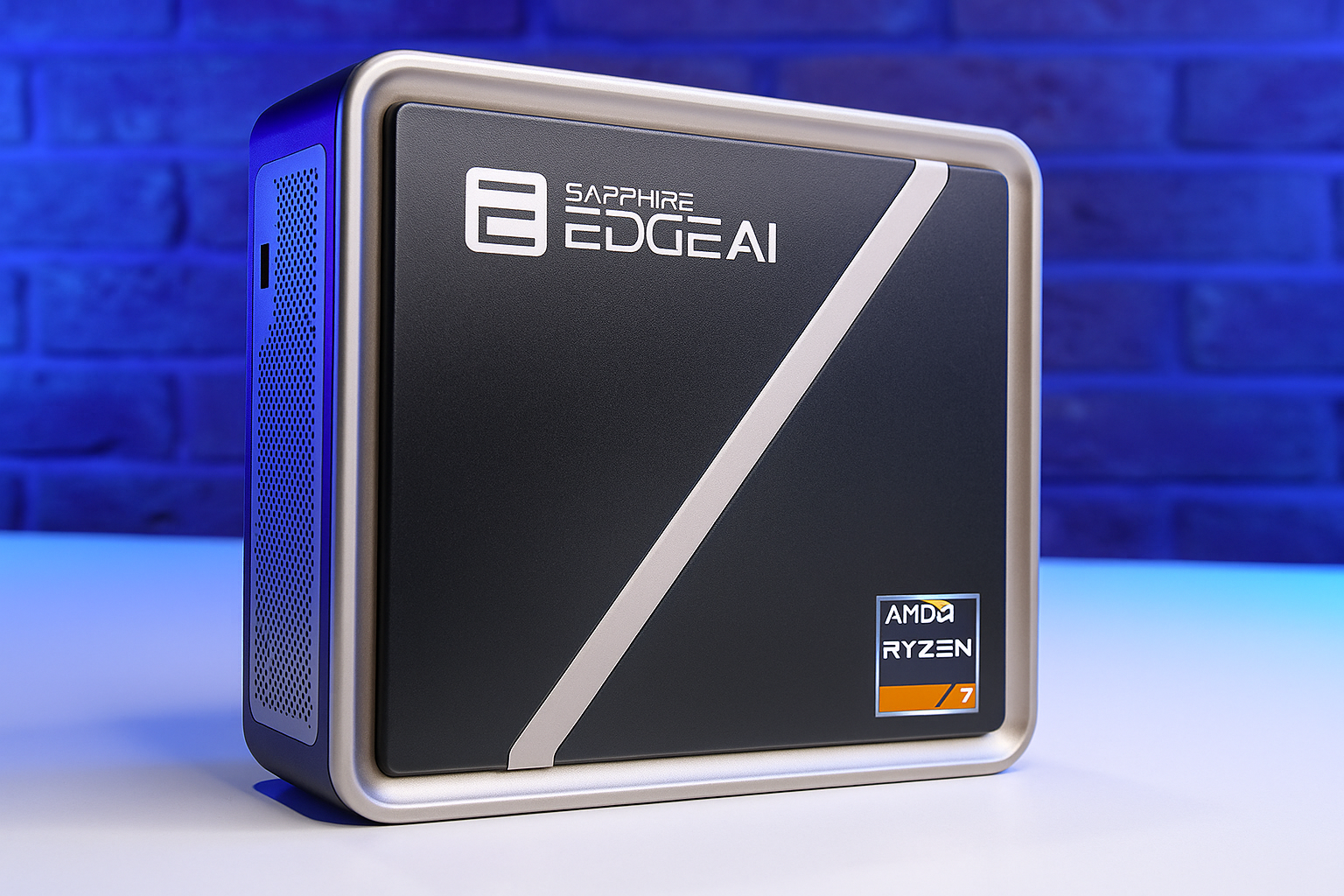
By The Sapphire Edge AI 370 is a new flagship in the tiny micro PC series from the well-known firm Sapphire Technology, which is known for producing high-quality graphics cards and embedded solutions. The Edge AI series’ concept combines maximum processing power with minimal space requirements, making it perfect for businesses, creative workers, and AI-based applications.
In addition to the top model with an AMD Ryzen AI 9 HX 370, the line also comprises the Edge AI 350 with Ryzen AI 7 350 and the Edge AI 340 with Ryzen AI 5 340. All models include the latest Zen 5 technology, integrated Radeon graphics, a powerful NPU, and a readily upgradeable, space-saving design. We evaluated the top-tier Edge AI 370 model in this review.
Specification
- CPU: AMD Ryzen AI 9 HX 370 (12 cores / 24 threads, up to 5.1 GHz)
- GPU: Integrated Radeon 890M (RDNA 3.5)
- NPU: XDNA2, up to 50 TOPS (Copilot-capable)
- Memory: 32 GB (2 × DDR5 SODIMM), expandable up to 96 GB
- Storage: 1 × M.2-2280 PCIe 4.0 SSD, Kingston OM8TAP41024K1, 1 TB
- Expansion Slots: 1 × M.2-2242 PCIe 4.0, 1 × M.2-2230
- Connectivity: 2.5 GbE Ethernet, Wi-Fi 6E, Bluetooth 5.2
- Rear Ports: 2 × HDMI 2.1, 2 × USB4 (PD), 1 × USB-A 3.2 Gen2, 1 × USB-A 2.0
- Front Ports: 2 × USB-A 3.2 Gen2, 3.5 mm audio jack
- Dimensions: 117 × 111 × 30 mm
- Special Features: Magnetic lid, VESA mount compatible
- Operating System: Barebone (supports Windows 11 or Linux)
Design and features
As soon as you unpack the Sapphire Edge AI 370, you can see how small it is. At 117 × 111 × 30 millimeters, the micro PC is slightly larger than one and a half 250-gram slabs of butter set side by side. This makes the Sapphire model similar in size to the Geekom IT15 with Intel Core Ultra 9, but substantially more compact than the Minisforum AI X1 Pro with its 195 × 195 × 47.5 millimeters and the Geekom A9 Max (135 × 132 × 46.9 millimeters), which also rely on the Ryzen AI 9 HX 370.
Despite its compact proportions, the Sapphire Edge AI 370 offers the performance of a fully-fledged desktop PC. The perfectly milled chassis with a matte black surface and golden accents appears high-quality and solid, and the design is carefully thought out.
The magnetically fastened top is particularly well-designed: all it takes is a flick of the wrist to access the RAM and SSDs. No tools and no need to remove rubber feet as with the Geekom A9 Max – simply lift off the lid, replace modules, and close. Sapphire has purposely flipped the internal layout such that the RAM and WLAN module are situated directly under the lid. This makes upgrades quick and straightforward — a detail that IT administrators appreciate just as much as ambitious power users.
Processor, GPU, RAM, and SSD
The central processing unit, the AMD Ryzen AI 9 HX 370, is based on a combination of four strong Zen 5 cores and eight efficient Zen 5c cores, i.e., a total of 12 cores and 24 threads with boost clock rates of up to 5.1 GHz.
The Radeon 890M, based on AMD’s RDNA 3.5 architecture, is used for the integrated graphics. The advantage also resides in a more direct contact with the CPU and memory. The system remains compact, efficient, and versatile. The XDNA2 NPU delivers up to 50 TOPS, which enables co-pilot functions without a cloud — a bonus for data privacy.
In contrast to cheaper compact PCs, Sapphire concentrates on the maintainability and endurance of its system. Instead of soldered LPDDR memory, the manufacturer, like Geekom and Minisforum, relies on changeable DDR5 SODIMMs, which are considerably slower in peak bandwidth, but are extensible up to 96 GB and inexpensive to repair. The test device has a Kingston OM8TAP41024K1 with a 1 TB capacity installed as mass storage; the Minisforum AI X1 Pro uses the same model.
The front has two USB-A connections and a 3.5 mm jack; the back has two HDMI 2.1 connectors, two USB 4 Type-C sockets with Power Delivery, more USB-A ports, and a 2.5 Gigabit LAN connection. The Edge AI 370, therefore, illustrates that “mini” is not synonymous with “limited”. The only niggling issue: a front USB-C would have polished the set. The device can also be installed inconspicuously behind monitors using the provided VESA mount – practical for workplaces, presentation rooms, or embedded applications
The two HDMI 2.1 connectors and the two USB4 ports, which may be utilized to connect up to four monitors with 4K resolution, are particularly remarkable. This means that the small computer can be utilized both as a multi-monitor center in the office and as a compact development or AI node. For the AI X1 Pro, Minisforum uses an internal power supply unit instead of an external one, which necessitates a larger enclosure. Conversely, Sapphire provides the Edge AI 370 with an extra 120-watt power supply unit.
This design keeps the waste heat outside the case, which supports quieter operation and stable performance. Even when installed in a hidden location, the small PC is still easily accessible thanks to the main plug’s secure connection and the long cord. With three programmable performance profiles, temperature-controlled fan curves, and a fan stop at low load, the BIOS further demonstrates Sapphire’s emphasis on usability.
Operating System
There is no operating system included with the Edge AI 370. Windows or Linux must be set up and installed by the user. Unlike the model of the Sapphire small PC provided to clients, our test device had Windows 11 24H2 installed, which we updated to version 25H2 Build 26.200.7019 via the operating system’s update mechanism.
Important note: After the first installation of Windows 11, multiple drivers are required, above all, the AMD drivers for the Radeon graphics card and the chipset. At the time of testing, Sapphire offers the essential drivers for Ethernet, WLAN, and Bluetooth for download on its websites, and an upgrade to version 2.10 is also available for the BIOS.
We won’t be taking a deep look at Windows, but we can see that the operating system effortlessly supports its AI functions in numerous locations.
Performance
With the new AMD Ryzen AI 9 HX 370, the Sapphire Edge AI 370 places itself today as one of the most powerful small PCs in its class and offers exceptional overall scores for CPU, GPU, and memory performance in the benchmarks.
The Ryzen HX 370 is based on the Zen 5 architecture with integrated Radeon 890M graphics (RDNA 3.5), which technically puts it well ahead of many contemporary Intel and AMD Ultrabook SoCs. In combination with 32 GB of RAM and a fast PCIe 4.0 SSD from Kingston, the result is a workstation that is ideally suited for classic office and productivity duties as well as computing-intensive applications and AI workloads.
The Edge AI 370 scored a very high 7,423 points, a level typically seen in high-end laptops or compact workstations. However, it falls slightly behind CPU-identical models like the Minisforum AI X1 Pro (8,292) and Geekom A9 Max (7,976 points), which come with 64 GB of RAM compared to the Edge AI 370’s 32 GB.
The benchmark sub-scores for Essentials (10,758 points) and Productivity (9,555 points) indicate that everyday tasks, office work, and multitasking run almost without any delay on the Edge AI 370. The Digital Content Creation score of 10,801 points is particularly notable, allowing the mini PC to outperform many full-sized desktop systems. Creative workflows, such as image or video editing, benefit from both the powerful CPU and the capable integrated GPU.
In the CPU profile, the HX 370 demonstrates its versatility: achieving 8,808 points in the multi-thread test and 1,166 points in the single-thread test, it delivers performance comparable to a mobile Ryzen 9 8945HS or Intel Core Ultra 9 285H. The excellent multi-thread scaling ensures that even demanding computations or parallel AI tasks are handled with ease.
The Time Spy score of 3,764 points highlights the GPU performance, which is about 30 to 40 percent faster than a system with Radeon 780M, though still below the 4,244 points of the IT15 with Intel Core Ultra 9 285H. The CPU score of 10,991 clearly places it in the high-performance segment, benefiting simulations, rendering, and AI workloads.
Modern benchmarks like Steel Nomad Light (3,285 points, 24.3 FPS) and Solar Bay (15,216 points) demonstrate that the Edge AI 370 performs strongly not just in theory but also in practical 3D and ray tracing scenarios. Geekbench AI Pro results (2,955 Single Precision / 6,616 Quantised) further confirm solid AI acceleration, which is particularly valuable for on-device AI tasks, edge computing, or local LLM inference.
The overall package is completed by excellent SSD performance measured in Crystal Disk Mark. With read speeds of 6,124 MB/s and write speeds of 5,250 MB/s, the storage performs at a desktop level, ensuring fast loading times and high responsiveness. These results are roughly comparable to the same SSD in the Minisforum AI X1 Pro and the Lexar LNQ7A1X002T in the Geekom A9 Max.
Conclusion
The Sapphire Edge AI 370 clearly shows how much computing power can be packed into a compact mini PC. Equipped with the AMD Ryzen AI 9 HX 370, Radeon 890M graphics, and an XDNA2 NPU delivering 50 TOPS, it ranks among the most powerful mini PCs currently available. In testing, it achieved over 7,400 points in PCMark 10 and strong results, making it ideal for office tasks, content creation, and AI workloads. Upgradeability is excellent, with support for up to 96 GB of DDR5 SODIMM and two NVMe SSDs, all easily accessible via the tool-free magnetic lid.
The high-quality chassis, solid build, and strong connectivity make the Edge AI 370 highly versatile. The fan is noticeable under sustained load but remains within acceptable limits. The only drawbacks are the absence of a front USB-C port and SD card slot, and the integrated GPU is not suited for AAA gaming. In summary, Sapphire offers a technically mature, future-proof system for professionals, developers, and AI users. The Edge AI 370 delivers a combination of performance, efficiency, and upgradeability, making it a top-tier mini PC.