 By
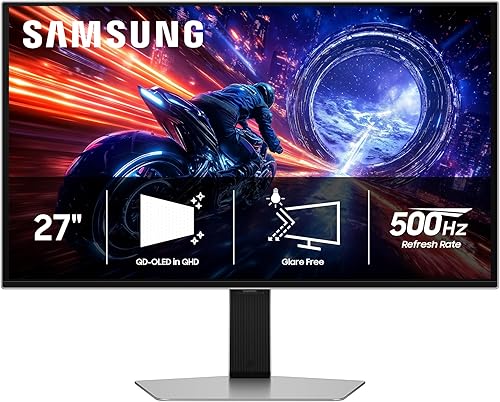
By The Samsung Odyssey OLED G60SF is a unique display for reasons other than its 500Hz QD-OLED panel. The G60SF has a sophisticated design and a matte display finish that maximizes use in a variety of lighting conditions, yet its super-high-refresh panel can handle world-class professional gaming.
Specs and features
The refresh rate of the Samsung Odyssey OLED G60SF, also referred to as the Odyssey OLED G6, can reach up to 500 Hz. It is one of just three QD-OLED displays with a 500Hz refresh as of late October 2025. The other two are the MSI MAG 272QP QD-OLED X50 and the Asus ROG Strix XG27AQDPG, which I have already evaluated.
- 26.5-inch display with a 16:9 aspect ratio
- 2560 x 1440 is the native resolution.
- Type of panel: QD-OLED
- Rate of refresh: 500 Hz
- Adaptive Sync: G-Sync compatible, AMD FreeSync Premium Pro compatible
- VESA DisplayHDR 500 HDR
- Two HDMI 2.1 ports, one DisplayPort 1.4 port, one USB-B upstream port, two USB-A 3.2 Gen 1 downstream ports, and a 3.5mm audio jack
- No audio
- Extra characteristics: RGB-LED lighting ring on the monitor’s back
- Cost: $999.99 MSRP
And since the Odyssey G60SF is essentially a standard QD-OLED display, its refresh rate will determine whether it succeeds or fails. It doesn’t have USB-C and only supports 1440p resolution. The MSRP of the display is $999.99, $100 more than the Asus substitute.
Design
The design of the Odyssey OLED G60SF is excellent. A few generations ago, Samsung changed to a more polished appearance, and the Odyssey G60SF offers the greatest version currently on the market. The rear of the panel resembles a high-end professional monitor rather than a gaming display since it is built of sleek, silver metal rather than plastic like most of its rivals. The look you’re going for will determine whether you like the Asus or the Samsung, although I really like the Asus.
The G60SF adds some flair with an eye-catching RGB-LED light ring, despite its overall modest appearance. In addition to being customizable, the ring has CoreSync, a technology that synchronizes the LED light with on-screen content to create a more immersive experience. However, unless your gaming area is extremely dark, CoreSync isn’t very obvious due to the low LED lights.
The G60SF takes up less room on your desk thanks to its tiny, flat base and strong stand. Although the majority of competitors have switched to this type of stand in recent years, it’s still worth mentioning because certain gaming monitors still use broader tripod-style platforms. The stand has height, tilt, and swivel adjustments as well as a 90-degree (or precisely 92-degree) pivot for portrait orientation. Additionally, third-party monitor stands and arms can be used with a 100x100mm VESA mount.
SDR image quality
Surprisingly, the Samsung Odyssey OLED G60SF features a Samsung QD-OLED panel. With only LG’s WOLED offering competition, this kind of OLED panel has emerged as the industry standard for OLED monitors. This is quite important because some LG WOLED displays have refresh rates as high as 480 Hz. In fact, every monitor I’ve included in the graph below has an OLED or WOLED refresh rate of either 500 Hz or 480 Hz.
With an SDR brightness of up to 320 nits, the Odyssey G60SF gets off to a wonderful start—a fantastic outcome for an OLED display. Brightness levels of about 250 nits were more typical as of 2024, but flagship displays are now beginning to reach 300 nits or higher. The G60SF performs better in spaces with ample sunlight or strong illumination due to its higher maximum brightness.
In addition to improving readability, Samsung’s matte display finish is a key factor in why buyers might pick the G60SF over a rival. The glossy coating of the majority of OLED monitors increases perceived contrast and vibrancy at the expense of more glare and reflections. In comparison, the G60SF has less glare at the expense of less perceived contrast and vibrancy.
Performance
However, it’s unlikely that you will purchase the G60SF for HDR. Although it isn’t strictly incompatible with HDR, you are purchasing it for motion clarity because most situations where you would play at 500Hz aren’t ones where you would want to use HDR. What counts most in this situation is motion clarity, which the G60SF provides.
The motion clarity of an ultra-high-refresh OLED truly must be seen to be believed, as I mentioned in my review of the Asus ROG Strix XG27AQDPG and earlier 480Hz displays. When you scroll through test photos for a game like DOTA 2, you can see almost every detail, even the ticks in hitpoint bars and the names above characters. Additionally, examples of scrolling text exhibit remarkable clarity. When the text is motionless, it is almost as easy to read.
To be clear, I don’t believe the new 500Hz QD-OLED panels and the 480Hz LG WOLED monitors from 2024 differ significantly in terms of clarity. However, 500Hz is very remarkable, and those who desire flawless clarity for competitive esports play will adore it.
If you use Nvidia G-Sync or AMD FreeSync Premium Pro, frame pacing will also be fluid. There is support for both adaptive sync standards.
Conclusion
If you’re looking for an OLED display with outstanding motion clarity, the Samsung Odyssey OLED G60SF is a fantastic option. At up to 500Hz, it produces a rich, colorful, and bright 1440p image.
The Asus ROG Strix XG27AQPDG, which shares the same Samsung QD-OLED panel, is marginally superior overall, which is the only issue with the G60SF. Better HDR performance, ELMB for improved motion clarity at refresh rates of 120 Hz and 240 Hz, and a tripod mount on top of the stand and a Windows app for controlling display capabilities make the Asus option somewhat more feature-rich overall.
Having said that, I am in a unique position as a reviewer since, if I had to choose between both monitors right now, I would choose the Samsung. Samsung’s design is my favorite. Additionally, I like the Samsung panel’s matte look over the Asus’ glossy one.
Therefore, even though the Asus unquestionably has more features at a lower MSRP, the G60SF is still a fantastic 500Hz monitor, and depending on your tastes, it might be the one to purchase.