By
By The Chinese manufacturer GMKtec is releasing the EVO-X2, a little PC that is firmly positioned in the high-end market and promises to further push the limits of small desktop PCs. GMKtec has a distinct strategy: maximum performance in the smallest of places, in contrast to many micro PCs that are primarily made for office duties, energy efficiency, or space conservation.
Thanks to cutting-edge Ryzen AI technology, the EVO-X2 should not only easily manage traditional workloads but also demanding AI operations, content production, and even gaming.
Specification
- Processor: AMD Ryzen AI Max 395 (16 cores, 32 threads, up to 5.1 GHz), 16 MB L2 cache, 64 MB L3, 120 watts TDP during continuous operation, and 140 watts during brief periods
- Graphics: Radeon 8060S (RDNA 3.5, 40 cores), with a maximum resolution of 7,680 × 4,320 pixels at 60 Hz
- NPU: XDNA 2, 50 TOPS (a total of 126 TOPS)
- Memory: Samsung 128 GB LPDDR5X 8,000 MHz hard-soldered
- Internal storage: Crucial P3 CT2000 PCIe M.2 2280 (second M.2 2280 slot, extendable to 2 x 8 TB), 2 TB PCIe 4.0 SSD
- Two USB-A 3.2 Gen2, one USB Type-C (USB 4.0), one 3.5 mm audio combo jack, and one SD card reader (SD 4.0, supports SDXC) are the front connectivity.
- One DisplayPort 1.4 HBR3, one HDMI 2.1, one USB-A 3.2 Gen2, two USB-A 2.0, one USB Type-C (USB 4.0), one audio (3.5mm CTIA), one DC-in, and one RJ45 are the rear ports. LAN
- Wi-Fi 7 (MT7925), LAN 2.5 Gbit/s (8125BG), and Bluetooth 5.4 connectivity
- Dimensions: 193 × 186 × 77 mm (W × D × H)
- 3.6 pounds in weight
Design
The GMKtec EVO-X2’s packaging, which is more than double the size of ordinary tiny PCs, makes it clear that it is not a regular mini PC. Indeed, the EVO-X2 is a genuine brick at about 3.6 pounds, as demonstrated by the contrast with the Sapphire Edge AI 370, the test’s smallest mini to yet.
The EVO-X2 is a huge, flat micro PC with a sandwich-like design, measuring 7.6 inches in width, 7.3 inches in depth, and 3.03 inches in height. The computer appears to be a serious desktop replacement in miniature form simply because of its size and weight, which communicate solidity and value.
The metal enclosure features all-around ventilation slits and a black center piece with a CNC jet-oxidized finish. Although the positioning of the rubber feet and cooling apertures is more conducive to upright use, the design permits the PC to be used either horizontally or vertically. Beneath the bonded rubber are the screws that open the housing. This makes upgrading a little more difficult.
The EVO-X2 may still be conveniently positioned on the desk or concealed beneath a monitor stand, even though the design offers enough capacity to cool the Ryzen AI Max 395. The EVO-X2 emits a faint blue from the ventilation slots while lacking overt visual tricks like RGB LEDs.
The “Fan Mode” button on the beveled edge stands out in addition to the standard connectors on the front and back (see below). This has a switchable fan control underneath it that you may use to change the cooling performance and loudness to suit your needs. It is necessary to enable the relevant setting in the BIOS for other small PCs.
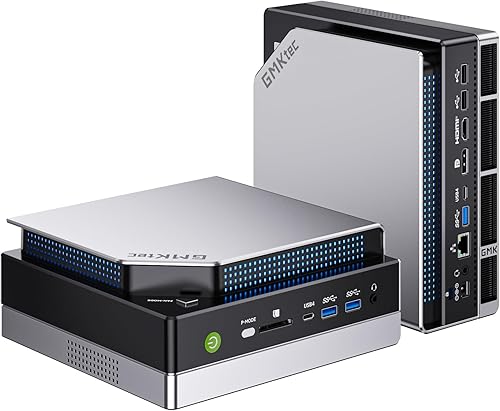
GMKtec EVO-X2 AI Mini PC AMD Ryzen Al Max+ 395 (up to 5.1GHz) Mini Gaming Computers, 64GB LPDDR5X 8000MHz (8GB*8) 1TB PCIe 4.0 SSD
Depending on the mode, the cooling system can operate much more powerfully when maximum performance is needed, such as while managing AI workloads, gaming, or rendering, or it can operate exceptionally silently for basic activities. This gives the user the freedom to choose whether the small PC should run as quietly as possible or make the most of its cooling to sustain higher clock rates for longer.
There is also the P-Mode (Performance Mode). At the push of a button, the GMKtec EVO-X2’s performance profile is triggered, setting the Mini-PC to its maximum speed in three steps.
Red, orange, and green little icons appear on the screen upon switching. In order to sustain higher clock rates for longer, the system raises the CPU, GPU, and NPU performance limits. In order to consistently disperse the extra waste heat, the cooling system operates more forcefully at the same time.
In actuality, this means that gaming, rendering, coding, and AI computations will require significantly more power, albeit with marginally increased noise and energy usage. Therefore, P-Mode is the best option if you want to take full advantage of the EVO-X2’s capabilities. We tested it in both performance mode and ordinary settings in the benchmarks (see below).
Features
The remarkable hardware combination of the EVO-X2 far surpasses what you would anticipate from a traditional tiny PC. Its core is the AMD Ryzen AI Max 395, which has 16 cores, 32 threads, and a clock speed of up to 5.1 GHz. It has already been produced in 4 nm.
With 40 compute units, the integrated Radeon 8060S is built on AMD’s RDNA 3.5 architecture. It provides unexpectedly good computation and rasterization performance despite its small heat budget due to the efficiency and shader enhancements from AMD’s current mobile high-end GPUs.
The 8060S outperforms earlier integrated Radeon generations and achieves frame rates in many contemporary games that were previously only possible with specialized notebook graphics cards like the Nvidia RTX 4070, thanks to its quick LPDDR5X memory.
In order to fully exploit AMD’s XDNA-2 engine, which has a total performance of up to 126 TOPS according to the manufacturer, there is also an NPU for AI loads with 50 TOPS. In addition to increasing efficiency, the NPU’s direct processing of models on the device significantly lessens the strain on the CPU and GPU, allowing for steady performance throughout extended inference (AI training) sessions.
This is especially beneficial for demanding AI workflows, such as image and video analysis, model quantization, or local LLM usage, since the NPU has been specifically designed for these computationally demanding, highly parallelizable operations.
We tested a variant with 128GB of Samsung LPDDR5X RAM running at 8,000 MHz (K3KLALAOEM-MGCV). A 2TB PCIe 4.0 SSD (Crucial P3 CT2000 PCIe M.2 2280) is also included. The EVO-X2 becomes a serious workstation basis thanks to this combo.
Operating system
Windows 11 Pro is pre-installed on the EVO-X2 and is instantly activated online upon initial startup. We upgraded the machine from Windows version 24H2 to 25H2 after completing the basic setup in a matter of minutes.
Important note: Many drivers are needed after Windows 11 is first installed, most notably the AMD drivers for the Radeon chipset and graphics card.
This guarantees that the Mini-PC operates under ideal circumstances and that every component may reach its maximum potential.
GMKtec’s English-language software is pre-installed with Windows 11. When testing the EVO-X2, it becomes evident what GMKtec means by the information on LLM support: the micro PC is built to run huge AI models locally on device—without the cloud. Numerous AI models can be loaded via the integrated app store.
It is rather easy to load local LLMs with more than 100 billion parameters when they have 128GB of RAM. This implies that the EVO-X2 can be utilized directly for more sophisticated AI activities that would normally only be feasible on powerful workstations. This is made possible by the hardware, which is what distinguishes the small PC from the entry-level or office segment.
Performance
Our test results make it evident that the EVO-X2 performs exceptionally well when heavy processing loads are needed. With 11,559 in “Essentials,” 10,853 in “Productivity,” and 15,527 in “Digital Content Creation,” the system’s default 10 score is 8,953.
Performance mode results: 9,078 points total, with sub-disciplines scoring 11,325, 11,153, and 16,074. The comparative values of devices like the Minisforum AI X1 Pro with the AMD Ryzen AI 9 HX 370 are substantially lower at 7,400 points, clearly placing the EVO-X2 in the upper group of usual tiny PCs.
The EVO-X2 is quite similar to full-fledged mid-range workstations when compared to contemporary desktop PCs: Many desktop computers with Ryzen 7 or Core i7 CPUs only receive comparable overall scores. In particular, the high score in the “Digital Content Creation” category reaches a level that is typically reserved for PCs with a dedicated GPU or a much higher performance budget.
The EVO-X2’s amazing proximity to the traditional desktop performance class for a tiny PC demonstrates how effectively AMD’s current APU design functions in conjunction with quick RAM and excellent power management.
Verdict
All things considered, the EVO-X2 offers CPU, GPU, and AI performance that is currently among the best in the class of tiny PCs. It provides what many other mini PCs only partially or not at all, striking a balance between a micro PC and a compact desktop workstation in its small size.
The EVO-X2’s well-balanced features set it apart from other modern micro PCs with AI or performance-focused processors. Even while the Ryzen AI 9 is a powerful processor, mini-PCs featuring the AMD Ryzen AI 9 HX 370, like the Minisforum AI X1 Pro and Sapphire Edge AI 370, fall well short of the EVO-X2’s peak performance.
Therefore, the EVO-X2 is more comparable to compact workstation PCs than to standard micro PCs in terms of AI and gaming performance. It can only be outperformed at high-end workloads by full-fledged desktop computers with dedicated GPUs and more potent, frequently more power-hungry processors. However, the Ryzen AI Max 395 is a remarkable advancement for a small PC—a forward-thinking option that either meets or surpasses the current specifications in many areas.
The EVO-X2 easily handles multitasking, parallel workflows, AI inference, and graphically demanding tasks in daily use. The EVO-X2 is now one of the most intriguing possibilities in the micro format for users who wish to run video editing, 3D modeling, AI projects, or just games at a high level. But it’s expensive—the full price of our test equipment is about $2,100.