 By
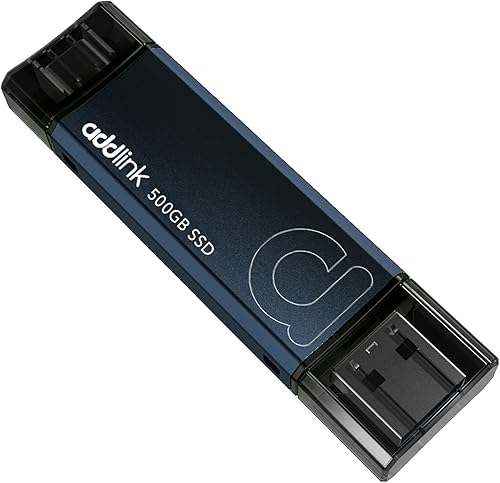
By Recently, I’ve noticed many USB flash drives with dual Type-A/Type-C ports on either end; this is a common way to ensure compatibility with the widest range of devices. Another such tiny, lightweight beastie that operates around the 10Gbps median with typical data volumes is the Addlink P50, which is evaluated here. However, when it runs out of secondary cache, write speed decreases substantially (to put it mildly).
Features
The P50 is a Type-A and Type-C USB 3.2 10Gbps (Gen 2) thumb drive. To protect the connector or connectors when not in use, each includes detachable end caps. The dimensions of the P50 are approximately 0.4 inches in thickness, 0.75 inches in width, and 3 inches in length. It weighs 16 grams, or 0.6 ounces. Steel blue was used to portray our unit, and the end caps were stained brown.
If I have any complaints about the well-made P50, it’s that the end caps are easily lost because they are not captive. At least for people like myself who are rushing and forgetful. The P50 has a three-year warranty from Addlink, which is standard for reasonably priced external storage. Although there was no TBW rating (terabytes that could be written before read-only) given the light-duty nature, the drive should last at least ten years.
What is the P50’s price?
As of this writing, the P50 was priced at $66.44 for the 500GB version, $104.44 for the 1TB version we tested, and $188.44 for the 2TB version (Amazon). That’s roughly how much the 10Gbps competition will cost. When there isn’t a percentage discount, why the forty-four cents? I couldn’t tell you. However, a calculator was undoubtedly used.
What is the Addlink P50’s speed?
Nevertheless, the 1TB PNY Duo Link V3 was the only 10Gbps drive (of all kinds) that it truly outperformed overall, and even then, it wasn’t by much. Although not as high as the 2TB Teamgroup X2 Max, the P50’s CrystalDiskMark 8 sequential throughput figures were respectable.
The one area where the P50 truly fell short of the Duo Link V3 was random operations, as revealed by CrystalDiskMark. However, the X2 Max also did.
Depending on the test, the P50 was within spitting distance of the X2 Max and occasionally the Duo Link V3 with typical large downloads (48GB is around a dozen 1080p, full-length movies). One unfortunate similarity between the Addlink P50 and the PNY Duo Link V3 is that after the secondary cache is out, it becomes extremely slow.
The P50 wrote the first 270GB of our 450GB file in around eight minutes. For 10Gbps, not too terrible. But writing the remaining 180GB took more than two hours. Oh no! During this second stage, the write speed was approximately 25 MBps. Frequently decreasing to 5MBps and occasionally rising to about 70MBps, but rarely for very long.
Despite being a 2TB drive, the Teamgroup X2 Max’s off-secondary-cache speed only decreased to about 675MBps, which is significantly faster than either of the other two drives displayed.
Conclusion
The P50 works well for light-duty storage and transportation. However, prosumers wishing to unload large volumes of content should go elsewhere (X2 Max), notwithstanding the Addlink buzz surrounding AI and 4K video. Or, at the very least, to the 2TB version, which will last longer.