 By
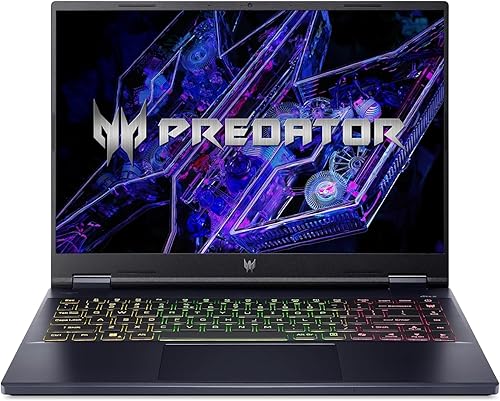
By Acer’s most recent attempt at a small gaming laptop is the Predator Helios Neo 14 AI (PHN14-71-939W). Although Razer may have invented the technique, numerous laptop manufacturers have adopted it, and several particularly remarkable models, such as the Asus ROG Zephyrus G14, have emerged.
Acer didn’t appear to fully commit to the concept, even though this trend is typically focused on design quality combined with reasonable performance that you wouldn’t anticipate from such a machine. Because of this, the Acer Predator Helios Neo 14 AI is a little too large and hefty in the name of performance, but it still lags behind standard gaming laptops that don’t care as much about their weight. Although the Acer Predator Helios Neo 14 AI still has several advantages, it ultimately falls short.
Specs and features
- Model number: PHN14-71-939W
- CPU: 285H Intel Core Ultra 9 processor
- Graphics/GPU: Nvidia RTX 5060 115W Memory: 16GB LPDDR5X-7467
- Display: 14.5-inch glossy, G-Sync, 2880×1800 OLED at 120Hz
- 1TB PCIe Gen 4 SSD for storage
- 1080p webcam IR.
- One Thunderbolt 4 with Power Delivery and DisplayPort Alternate Mode, one USB-C 3.2 Gen 2 with Power Delivery and DisplayPort Alternate Mode, two USB 3.2 Gen 2 Type-A, one HDMI 2.1, one microSD card reader, and one 3.5mm combination audio
- Bluetooth 5.4 and WiFi 6E for networking
- Biometrics: Windows Hello facial recognition
- 76 watt-hours of battery capacity
- Measurements: 12.77 x 10.07 x 1.02 inches
- 4.14 pounds in weight
- As-tested MSRP: $1,699 ($1,699 basic)
The base model, which costs $1,699, is what we tried. You may upgrade to a configuration with an RTX 5070 and get twice as much system memory for $1,899. This is a pretty practical option, especially because you can’t upgrade the RAM after purchasing.
Design and build quality
With this iteration, Acer doesn’t seem to have made many changes to the laptop’s external design. A wider cutout above the display to accommodate an IR-backed webcam and a redesigned keyboard deck are two of the minor adjustments. However, with mostly under-the-hood improvements, the Predator Helios Neo 14 AI seems to be an improvement over the previous Helios Neo 14 model.
This gives you a gaming laptop that is lightweight and somewhat small, but it isn’t really innovative. Despite having a thin design, the Predator Helios Neo 14 AI weighs 4.14 pounds, and its thickest point—which includes rubber feet—is little more than an inch thick.
Additionally, Acer made the poor decision to significantly protrude at the back for exhaust, giving the system a depth of 10.07 inches that made it difficult to fit into a laptop sleeve. The rear exhaust port seems to be mostly unnecessary, which is a bummer. The final half-inch or so of the space is basically empty because Acer didn’t fill it with a large radiator stack.
The remainder of the laptop’s construction is mediocre at best. The keyboard deck of the Predator Helios Neo 14 AI is made of plastic; however, the display lid and base are made of aluminum. Additionally, plastic bezels surround the display on both sides. The laptop feels rather strong, but I don’t like how much the display flexes and how the base creaks. The display is securely held in place by the hinges, which don’t move much when the screen is moved. Additionally, the laptop’s base is heavy enough to hold it in place and enable one-handed laptop opening.
The Predator Helios Neo 14 AI has been configured by Acer to draw in air from both the top and bottom of the device. A big grille above the keyboard conceals what are actually relatively small intakes for the task. With vents on the sides and back of the laptop, the exhaust takes up nearly the whole back half of the base.
The laptop is held firmly in place by Acer’s four rubber feet, which also give the bottom vents some space. Acer has a lot to say about the system’s cooling architecture, but ultimately, what matters is how efficient and loud (or quiet, preferably) it is.
Luckily, the Predator Helios Neo 14 AI passed 3DMark’s Steel Nomad Light Stress Test since there was enough airflow for it to function reliably under load. When the system is operating at a high load (especially in the Turbo mode), the fans make a little noise, but this is usually not an issue.
Although the Predator Helios Neo 14 AI has a respectable appearance, it’s difficult to avoid comparing it to the Asus ROG Zephyrus G14—not only because I recently tested that laptop, but also because both devices are targeting the same market. Acer’s laptop appears and feels like a disappointing also-ran in that competition. It feels less expensive, is heavier, thicker, and less attractive. In fairness, it is less expensive, but not significantly. It has a Kensington lock slot, at least.
Keyboard and trackpad
The Predator Helios Neo 14 AI features a difficult-to-love keyboard, much like almost every other Acer laptop I’ve tested. Keycaps expand somewhat, pushing me to the edges instead of having useful contours to guide my fingers to the middle of each keycap. Additionally, I may end up rolling off corners a little if I don’t have strong stability.
Additionally, there is uneven tactility since the centers and edges of the keys depress in different ways. Only because of the Acer keyboard’s consistent design have I been able to become so familiar with the peculiarities of these keyboards that I can type more than 110 words per minute in Monkeytype with a respectable level of accuracy, though this speed is never confident or comfortable.
Acer reduced the size of the right shift key to fit full-size arrow keys, which may make using it more time-consuming. Additionally, Acer added a column of additional media control keys to the laptop’s right side. The main keyboard is moved slightly to the left of the laptop’s centerline as a result, which might not be a problem for gaming, but makes typing on the laptop a little more difficult.
The entertaining RGB lighting on the Predator Helios Neo 14 AI keyboard successfully lights up the complete legends on the keys. However, it does not provide per-key personalization; it is only three-zone lighting. PredatorSense showed that Windows controls this lighting by default. However, there was no shortcut to the Windows settings for keyboard lighting, and this strangely caused the built-in keyboard shortcuts for changing lighting levels to not function consistently.
The Predator Helios Neo 14 AI’s trackpad is passable but unimpressive. It is sensitive and fluid. The actual click has an unsatisfactory thud and is a little stiff. Despite being sufficiently large, it feels nearly insignificant when compared to the Asus ROG Zephyrus G14.
Connectivity
When it comes to the system’s port options, Acer has done a terrific job. It has USB-A and USB-C ports on both sides, with both USB-C ports supporting DisplayPort Alt Mode for video output and 90W PD power input. The remaining USB ports are all 10Gbps ports; only the left USB-C port offers Thunderbolt 4 speeds. The right side has a microSD card slot and an HDMI 2.1 (48Gbps) port.
A 3.5mm headphone jack on the left completes the options offered by Acer. A barrel power adapter for the accompanying power brick is also present on the left edge. On lighter gaming laptops, it’s always nice to have the option to leave the bulky power brick at home and utilize a portable USB-C charger.
These ports are not as well-positioned. All of the ports are moved forward to the front edge of the front part of the system since exhaust vents take up much of the laptop’s rear. Because of this, using the laptop with peripherals connected may become a little awkward.
Performance
The Predator Helios Neo 14 AI is prepared to be a powerful machine with enough CPU performance and respectable, if not mind-blowing, GPU performance, as can be seen from just a cursory glance at the specs sheet. Although there are a few instances where it falls short, the Predator Helios Neo 14 AI generally succeeds.
The Predator Helios Neo 14 AI’s excellent overall performance is demonstrated by PCMark 10, which gives it a very respectable score. Even more powerful GPUs than the RTX 5060 enable certain gaming laptops to push higher, but anything over 5,000 points is really impressive.
If its storage hadn’t been a barrier, the Predator Helios Neo 14 AI might have risen much farther. Even while the system’s SSD achieved over 7,100MB/s sequential reads and 6,100MB/s writes in CrystalDiskMark 9, its random read and write speeds were only about 380MB/s, which is slower than some older SATA SSDs.
The Predator Helios Neo 14 AI benefits greatly from the Core Ultra 9 285H. With its 16 cores offering superior multi-core performance that the AMD competition can’t quite match, it gives the machine a strong advantage over the majority of its rivals. Although it is more easily matched by the AMD Ryzen AI 9 365 found in the Razer Blade 14 (2025), its single-core performance is still outstanding.
Newer isn’t always better, though, as the Lenovo Legion 5i 15IRX10’s Intel Core i7-14700HX consistently outperforms the Predator Helios Neo 14 AI in single-core and multi-core tests. This is probably because the earlier chip’s 8P+12E configuration completely skips Low Power Efficient-cores and hits a higher max turbo frequency. Nevertheless, the Predator Helios Neo 14 AI even managed to win our Handbrake encoding test, making it a really close contest.
Battery life
The Predator Helios Neo 14 AI doesn’t perform poorly, but it also doesn’t stand out. Performance and battery life require careful balancing. Before its 76Wh battery ran out, it completed our 4K local video playback test for slightly more than five hours. This provides it a much-needed victory over the Lenovo Legion 5i 15IRX10, which consistently outperformed it in performance tests.
However, it is still not as long-lasting as the Lenovo LOQ 15 15AHP10’s little 60Wh battery, much alone the Asus ROG Zephyrus G14, which lasted nearly 13 hours on a 72Wh battery.
The Predator Helios Neo 14 AI’s actual battery life is typically between four and five hours, and even that may require some cautious use of the display’s brightness.
Conclusion
Although it’s a capable device, I wouldn’t suggest the Predator Helios Neo 14 AI. With a weight of more than four pounds and unusual dimensions that can make it difficult to fit into laptop sleeves, it falls short of the competition for lighter and thinner gaming laptops.
This promise is better fulfilled by the Asus ROG Zephyrus G14, which also has a better design, an equally good display, a longer battery life to complement its portability, and comparable performance (which occasionally catches up in Turbo mode) at a comparable price.
Additionally, the Lenovo Legion 5i 15IRX10 demonstrated that it can outperform the Predator Helios Neo 14 AI at a significantly lower cost when raw performance is more important than portability. The Predator Helios Neo 14 AI continuously shows itself to be good, but not good enough, when compared to its competitors.