By
By A 13.3-inch laptop, the HP OmniBook 7 Aero weighs 2.2 pounds or less, depending on the configuration you select. It feels high-end because of its stunning white design and magnesium-aluminum alloy chassis made entirely of metal. It also operates quietly and coolly. It seems like this equipment was designed to be portable.
Regretfully, HP combined an AMD chip that isn’t as power-efficient as the most efficient CPUs available from Intel and Qualcomm with an oddly small battery. As a result, you never want to take the ultraportable too far from an outlet. This laptop would have been truly impressive if it had had a larger battery or an Intel Lunar Lake CPU.
Specification
The AMD Ryzen AI 7 350, which has eight cores and Radeon 860M graphics, powers the HP OmniBook 7 Aero. AMD’s Ryzen AI hardware, which has an NPU quick enough to handle Windows 11’s Copilot+ PC features, offers a decent balance between speed and battery life.
For a lightweight ultraportable like this one, the 32 GB of RAM and 1 TB SSD in our review model is more than sufficient. Considering the other components in this system, the RAM in particular appears to be a bit overspecified. A speedier CPU and 16 GB of RAM would be more beneficial for the majority of users.
Despite the considerable quantity of RAM, the $1,299 retail price point feels a little excessive given the AMD Ryzen AI 7 350 CPU, which is in the mid-range. However, HP was selling it for $869 at the time I was finishing this review. It feels like a great price for this machine.
- HP OmniBook 7 Aero 13-bg1077nr is the model number.
- AMD Ryzen AI 7 350 CPU
- 32 GB of LPDDR5x-7500 RAM
- GPU and graphics: AMD Radeon 860M
- AMD NPU (up to 50 TOPS) as the NPU
- 13.3-inch 2560 x 1600 IPS display with a refresh rate of 60 Hz
- 1 TB PCIe Gen4 SSD for storage
- The webcam is 1440p.
- Two USB Type-C (10 Gbps), two USB Type-A (1 10 Gbps, 1 5 Gbps), one HDMI 2.1, and one combination audio jack are all connected.
- Networking: Bluetooth 5.4, Wi-Fi 6
- Biometrics: Windows Hello IR camera
- Capacity of the battery: 43 Watt-hours
- Dimensions: 11.70 x 8.31 x 0.69 inches
- 2.2 pounds in weight
- MSRP: $1,299 as tested
Design and build quality
The HP OmniBook 7 Aero impresses right away. In a world of silver laptops, the Ceramic White model, which we reviewed, has an exceptionally sleek appearance. (HP has a “Glacier Silver” version as well.) Despite the black bezel surrounding the monitor, the keyboard deck is also white.
One of the lightest laptops I’ve ever reviewed is this 13.3-inch device. HP claims that, depending on the hardware combination you select, it can weigh up to 2.2 pounds. The metal chassis, made of magnesium-aluminum alloy, has a somewhat springy feel that makes it comfortable to hold, and it’s about as light as a laptop can get.
Although the hinge feels sturdy and free of annoying wobbles, the machine is so light that I have to use two hands to open it.
The laptop has more bloatware than I would want to see; for example, the Start menu contains keys to Booking.com, Adobe Offers, and “Dropbox promotion.” If you do not want this, however, it is simple to remove.
Keyboard and trackpad
The chiclet keyboard of the HP OmniBook 7 Aero is comfortable to type on. It also has a lovely white backlight. The typing motion is really responsive and quick. However, the key travel is a bit shallow, which makes it seem a little strange. Given that the laptop weighs 2.2 pounds and has a maximum thickness of 0.67 inches, this is not shocking. Although HP has done a good job of making up for the thinness, it still seems a bit shallow.
The trackpad on this machine feels nice as well. With a lovely “clunk” sound when you click down, this regular mechanical trackpad is a decent size and feels responsive to finger movements.
Display and speakers
The 13.3-inch IPS display on the HP OmniBook 7 Aero features a good anti-glare surface with a resolution of 2560 x 1600 pixels. It appeared to be significantly brighter than HP’s 400 nits rating. Although the display is stunning, it only has a 60Hz refresh rate; a higher rate would have been preferable.
But the combination of a good level of brightness, superb resolution, and an anti-glare surface is a true winner. In difficult lighting situations, such as direct sunshine, it outperforms glossy screens. Although it isn’t a touch screen, the display is one of this machine’s best features.
I play Daft Punk’s Get Lucky and Steely Dan’s Aja to test the speakers on each laptop. A respectable amount of high-end volume is delivered by the HP OmniBook 7 Aero. The audio quality was mediocre; Get Lucky’s bass was not as strong as usual, and the highs could be a bit annoying, especially at full intensity. To enjoy music, movies, and TV shows to the fullest, I would use headphones.
Connectivity
For a 13-inch laptop weighing only 2.2 pounds, the HP OmniBook Aero boasts a respectable amount of connectors. A USB Type-A port with a 5 Gbps speed limit and a combination audio jack are located on the left side.
There are two USB Type-C connectors (both 10 Gbps speeds), an HDMI 2.1 port, and a second USB Type-A port (up to 10 Gbps) on the right side. The charging cable should be plugged into one of the ports on the right side of this device since it charges via USB Type-C.
Despite the lack of USB4 and Thunderbolt 4, the port variety is decent. Neither an Ethernet jack nor a microSD card reader are present. If those are crucial to you, you will need a dongle.
This machine’s Wi-Fi is a little outdated, as it only supports Wi-Fi 6 and Bluetooth 5.4. The model we evaluated didn’t have Wi-Fi 7 or even 6E. It’s not a major issue, though, as you have most likely not yet made the conversion to Wi-Fi 7.
Performance
With its AMD Ryzen AI 7 350 CPU, the HP OmniBook 7 Aero offered respectable desktop performance for common desktop applications, including as productivity, communication, and web browsers. It also ran quietly and coolly. That’s probably what people will use this 2.2-pound ultraportable laptop for!
As usual, we test this machine’s performance using our standard benchmarks.
To get a sense of the overall performance of the system, this device behind AMD Ryzen AI 9 HX-powered devices like the HP OmniBook Ultra 14 and Intel Lunar Lake-powered devices like the Samsung Galaxy Book5 Pro 360.
In the Lenovo IdeaPad Slim 3, this AMD hardware was in close competition with Intel’s slower Intel Core 5 210H chip. The AMD hardware is a superior option because it is a more recent CPU with an NPU that can operate Copilot+ PC functions and it runs cooler.
Cinebench R20 is then used. This benchmark, which emphasizes total CPU performance, is substantially multithreaded. Since it’s a fast test, cooling isn’t an issue for prolonged workloads. However, CPUs with more cores have a significant advantage because it is massively multithreaded.
AMD’s “AI PC” hardware demonstrated its superior multithreaded performance than Intel’s “AI PC” hardware with a multithreaded score of 5364. Here, AMD outperformed Intel.
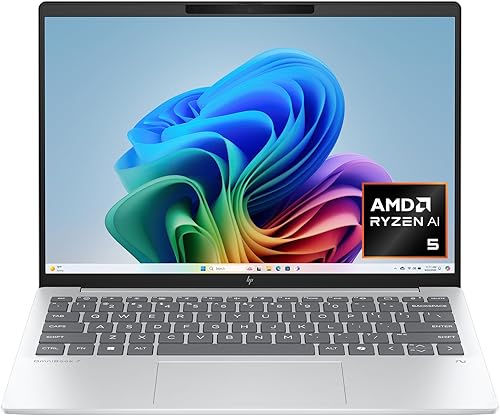
HP OmniBook 7 Aero 13.3 inch Next Gen AI PC, 2K Display, AMD Ryzen AI 5 340, 16 GB RAM, 512 GB SSD, AMD Radeon 840M Graphics, Windows 11 Home,
We also use Handbrake to run an encode. Although it runs for a long time, this benchmark is also significantly multithreaded. Under load, many laptops choke and slow down, requiring the cooling system to kick in.
The encode process took the HP OmniBook 7 Aero an average of 1,199 seconds, or almost 20 minutes. It surpassed Intel’s Lunar Lake hardware once more in terms of performance, but as we’ll see below, Lunar Lake will prevail in terms of battery life.
A graphical benchmark is then run. Even though this laptop isn’t meant for gaming, it’s still a good idea to see how the GPU functions. We use the GPU performance-focused graphical benchmark 3DMark Time Spy.
The Radeon 860M graphics here function similarly to onboard graphics, even though AMD is known for producing powerful graphics technology. This machine’s overall 3DMark Time Spy score was 2,726, which is half that of Intel’s Lunar Lake GPUs.
All things considered, the HP OmniBook 7 Aero performs admirably for this class, particularly while multitasking. And it remains silent and cool while doing it. However, the performance of 3D graphics is a specific flaw.
Battery life
With a 43 Watt-hour battery, the HP OmniBook is a little device. Fortunately, this machine’s AMD Ryzen AI hardware uses a fair amount of electricity. Although this computer has a respectable battery life, it falls short of what is considered to be a lightweight PC in 2025. However, this machine would get heavier with a larger battery. The light weight is a result of the smaller battery.
We repeatedly play a 4K version of Tears of Steel on Windows 11 with airplane mode turned on until the laptop suspends itself in order to test the battery life. For battery benchmarks, we adjusted the screen brightness at 250 nits. The actual battery life in daily use will always be less than this.
Before suspending itself, the HP OmniBook 7 Aero ran for an average of 632 minutes, or ten and a half hours. Although it’s a fantastic figure for a computer with such a small battery, laptops with larger batteries outperform it. The battery life of this laptop might be more than doubled with a larger battery and an Intel Lunar Lake system. HP is stretching the envelope by combining this battery with AMD hardware, even though Lunar Lake computers might be able to get away with a battery this small.
Conclusion
The HP OmniBook 7 Aero is a tiny laptop wonder. I enjoyed using it, and I loved picking it up and carrying it around. It weighed 2.2 pounds and had a gorgeous white all-metal design. It also remained silent and chilly.
Sadly, HP’s choice to add a little battery—perhaps to lighten the device—feels like a compromise that reduces this machine’s usability.
When I initially handled this laptop, I was enamored with it, but when I saw the battery specs, I grimaced since 43 watt-hours is simply too little for this AMD chip. This figure was acceptable in the past, but it is low in the post-Lunar Lake and post-Qualcomm Snapdragon X reality.
This might be the perfect laptop for you if you’ll always be close to an outlet and you need more multithreaded CPU performance than Intel’s Lunar Lake can provide.