 By
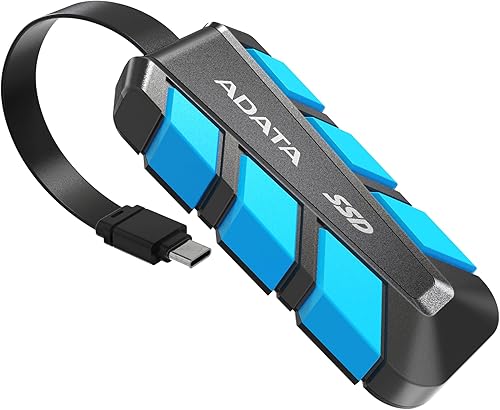
By I was prone to like the Adata SD820 right away because I’m blatantly shape-conscious. It is simple to identify in the wild thanks to its vivid blue highlights, which are a little gaudy in bright light, but I appreciate that. The offer was made sweeter by the fact that it has 2TB on board and performs well at 20Gbps. both practical and appealing. What’s not to enjoy?
One thing, though. The drive will run out of secondary cache and slow to about 130 MBps if you write too much data at once (more than 20% of its capacity). Apart from that, the SD820 demonstrated the fastest real-world performance of any 20Gbps SSD.
Features
The SD820 is a tiny, flat-ish, black-and-blue rectangle that is about 0.4 inches thick, 2.65 inches long, and 1.5 inches broad. It is only 0.9 ounces in weight.
Given its IP68 classification, it is more than appropriate for outdoor use. IP68 indicates that the SD820 is dustproof and can withstand submersion in water up to 10 feet deep, if you’re not interested enough to go on that link. When it comes to consumer electronics, that is the best available.
The controller is a Silicon Motion SM2322, the NAND is stacked QLC, and the SD820 is a 20Gbps USB 3.2×2. In most Thunderbolt ports and all non-USB4 ports, USB 3.2×2 decreases to 10Gbps or less. It is 20Gbps when connected to a specialized USB 3.2×2 port and select USB4 ports.
The SD820 has a five-year warranty from Adata, which is two years longer than most external SSDs. A TBW (TeraBytes that may be Written) rating was not provided by the company; nonetheless, QLC of this type (older) typically has a capacity of about 250TBW per terabyte.
Pricing
As of mid-November 2025, the SD820 will be offered in $102/1TB and $179/2TB capacities, with a 4TB capacity coming later. Although the exact cost is unknown, I would estimate it to be roughly $400. For 20Gbps SSDs with an IP68 rating, that is not at all awful. If you want greater write performance with big volumes of data, it will be much more expensive. You can go a little cheaper without the IP-rating. Regarding that…
Speed
The SD820 is one of the quickest 20Gbps SSDs we’ve tested when data volumes are typical. Though still extremely quick overall, it is faster in sequential throughput than random operations.
The SD820 lagged far behind its competitors at 4K writing, despite the fact that 4K reads are competitive. Not terrible, not amazing, all in all.
It was during our 48GB transfer testing that the SD820 truly excelled. It is the fastest of all the 20Gbps SSDs and enclosures we’ve tested, cutting several seconds off the times of the two competitors listed, the Corsair EX400U and Crucial X10 (selected due to their comparable bulk).
When it reached around 85% of the way through the 450GB write, the SD820 was actually on schedule for a substantially faster time before running out of secondary cache (second image below). The sea anchor on a competitive time was dropped by the QLC’s inherent write speed of 130 MBp.
This is a screenshot showing the native write slowdown at 85%. Since we’ve seen newer QLCs retain 400Mbps to 500MBps, the QLC must be older. Basically, though, you might want to consider a TLC SSD if you write this much data on a regular basis (which not many people do, including us outside of testing).
The best portable 20Gbps SSD for real-world transfers of typical size is the SD820. However, if users frequently write a lot of data, a device with TLC NAND and USB4 might be more beneficial to them in the long term.
Conclusion
Examine the Adata SD820 closely if you’re searching for durable storage at a reasonable cost and like the way it looks. Although the SD820 isn’t quite pro-level, the typical user, particularly those operating in the wild, can readily utilize it because it’s fast and wide enough.